I. The window
Two documents were issued on Friday 12 June 2026, a few hours apart. The first was a trading confirmation: Space Exploration Technologies Corp. opened on Nasdaq at $150 a share, having priced the largest initial public offering in history the evening before: $75bn of stock at $135, rising towards $86bn once the underwriters exercised their option. The second was a strongly worded letter, addressed to Anthropic’s leadership. The Commerce Department, citing national security authorities, directed Anthropic to cut off access for any foreign national, irrespective of location, to Claude Fable 5, its latest commercially available AI model, released to the public just days before. The order extended to Anthropic’s own foreign-national employees, which meant, operationally, that the company could not comply and keep the product running. It took the model dark for every customer it had, and the model stayed dark for nineteen days.
One Friday, two events: in the morning the AI financing cycle got the largest cheque ever written for it (or for much of anything else, ever), and by the afternoon the United States government had demonstrated that the asset class’s primary product category could be switched off by letter. The window that the entire accelerated-computing financing stack spent 2025 waiting for is now ninety days old: this piece is an inventory of what has come through it.
The Keystone, from three months ago, described the architecture that made the window matter: a financing stack of vendor equity, prepaid compute contracts, collateralised neocloud debt and hyperscaler guarantees, assembled in a specific dependency order around one load-bearing element: a public offering by OpenAI, at a trillion dollars or more, in the second half of 2026. It listed six preconditions that all had to hold for that keystone to carry the load, and it noted, as a concession that kept the argument honest, that nothing in the arrangement was fraudulent: the disclosures existed, for anyone with the twenty hours required to read them. Ninety days of the window have now been consumed. A record AI listing has been completed and has sunk below its offer price. The largest equity raise ever conducted, a record that stood for eleven days, has been executed by a company that did not need the money. A more profitable rival has filed to go public first. The anchor tenant’s largest landlord’s credit rating has been cut to one notch above junk. And the offering everything else depends on has, according to the people advising it, begun sliding towards next year.
Each of these events tests a different precondition, and this piece takes them in turn before re-scoring the original list, including the entry the Keystone itself got wrong. It is written in mid-July 2026, deliberately before OpenAI prices anything: the Keystone went on the record in April before the window opened, and this goes on the record before it closes. The Keystone’s concession — legal at every joint, disclosed at every step — survives the ninety days intact. What has not survived is the assumption underneath it, which is that the joints stay where they were built. The evidence below includes an exchange that rebuilt its inclusion rules in a public consultation concluded six weeks before the listing, a regulator that consented six months beforehand to retire the settlement that policed underwriter research, and a government that has attached conditions to the release calendars of the industry’s flagship product category. The disclosures exist. The rulebook they are filed under has been moving. The old lawyers’ adage “if you don’t like the facts, point at the rules; if you don’t like the rules, point at the facts; if you like neither, slam the table and make lots of noise” got an update: if you like neither, change the rules.
90 days
How long the AI financing window described in The Keystone has been open — this piece is an inventory of what has come through it.
II. A sudden change in orbit
The Keystone described a category of company it called the neocloud: a capital structure wrapped around GPUs, renting out wholesale compute to a handful of anchor tenants, financing the hardware with debt collateralised by the tenants’ contracts, its equity held in meaningful part by its own supplier. The category’s defining feature was that capital expenditure ran far ahead of revenue, bridged by paper whose value depended on the would-be tenants’ promises being kept. CoreWeave was the type specimen. SpaceX joined the category late, deliberately, and in the weeks before it listed.
When SpaceX absorbed xAI in February, the transaction was described as a merger of Musk’s ventures, and what it absorbed was a frontier lab losing the model race: Grok holding a global share in the low single digits, its US share drifting down from a January peak, its daily usage in decline since March by the app trackers’ count, and its next flagship missing two release windows in a row. The merger also put a frontier lab’s economics on a public record for the first time. In 2025, xAI lost $6.36bn on revenue of $3.2bn. In the first quarter of 2026 it posted a $2.47bn operating loss on revenue of $818m, while the AI segment’s capital expenditure ran to $7.7bn in the quarter, an annualised rate above $30bn and roughly double the prior year’s pace. Consolidated, SpaceX lost $4.94bn in 2025 on $18.67bn of revenue, and $4.28bn in the first quarter of 2026 alone. The launch business and Starlink, both real and both growing, function in this structure as the collateral: the cash-generative wrapper around a frontier lab burning ten dollars of capex and four dollars of opex for every dollar of AI revenue.
The conversion into the Keystone’s category came in the weeks before the listing, dated and priced. On 6 May, SpaceX signed Anthropic as tenant for some 325,000 GPUs across Colossus 1 and 2, the facilities xAI had built in and around Memphis to train Grok: $1.25bn a month through May 2029, terminable by either side on ninety days’ notice once an initial three months have run, with Grok’s own training — Grok-5 included, per the prospectus — now confined to Colossus 2. On Friday 5 June, one week before pricing, Google signed for a further $920m a month. A frontier lab that had booked $818m of AI revenue in the first quarter acquired $6.5bn of quarterly rental run rate in thirty days, and the prospectus language followed: “substantial flexibility in how we allocate and monetise capacity.” The anchor paying $1.25bn a month is the company whose product the US department of Commerce switched off on the day SpaceX listed; the $920m tenant is the company that had executed the largest equity raise in history four days earlier. The company built to beat its rivals’ models would list as their landlord, with the lease revocable on ninety days’ notice by tenants who are also its competitors: the Keystone’s neocloud anatomy adopted, in the end, not as a diagnosis but as a business model.
There is a structural reading of those deals that’s not in the prospectus. By filing first at record scale, SpaceX had made itself a keystone of the same arch it was joining: a failed, or even disappointing, listing in June would have shut the window through which OpenAI, and in time Anthropic, intend to pass, and set the comparison print against which every later AI offering would be priced. Anthropic’s need for the capacity was real: it was rationed before the lease and lifted its usage caps the day the deal was announced. Google’s position is older: a shareholder since 2015, holding a stake worth more than $100bn at the listing price. But note what the two contracts did, and when. They converted a loss-making model lab into a landlord with $6.5bn of additional quarterly rental revenue in the thirty days before the book was built, signed by two counterparties with their own reasons to want the IPO to succeed.
The balance sheet that was marketed in June was assembled in the four months before. Musk’s 2022 acquisition of Twitter left roughly $12.5bn of leveraged-buyout debt; xAI acquired X in 2025 and assumed it, then added $5bn of its own borrowing, including $3bn of senior secured notes paying 12.5 per cent. SpaceX’s acquisition of xAI in February 2026 brought the whole pile onto the combined balance sheet. On 2 March, a $20bn bridge facility arranged by Goldman Sachs, Morgan Stanley, Bank of America, Citigroup and JPMorgan retired $18.9bn of it in a single stroke, replacing the obligations rather than reducing them; the 12.5 per cent noteholders were taken out at roughly $1.17 on the dollar. The bridge carried an effective rate of 4.58 per cent, roughly halving the annual interest bill of about $2bn, and a covenant: SpaceX was required to apply proceeds from the IPO, or from any debt raised after it, to repayment within six months. On 12 June the company listed, marketing a balance sheet cleaned by the bridge. On 16 June, four days later, it exercised an option it had written in April and disclosed in the prospectus: the acquisition of Anysphere, maker of the Cursor coding tool, for $60bn in stock, with $10bn in termination and deferred-services fees as the price of walking away. The first act of the new public company was to spend, in stock, a sum equal to seventy per cent of everything the IPO had just raised in cash, on a commitment struck before the shares were sold, at the expense of shareholders of four days’ standing. On 22 June it launched its first bond: roughly $20bn of senior unsecured notes, sold under Rule 144A to qualified institutional buyers only, a market the penalty-held retail tranche cannot enter, for the stated purpose of repaying the bridge in full. The shares fell 16 per cent on the Monday of the bond announcement, ending a week in which both facts had landed. However the fall is apportioned between them, together they established that the IPO cash would not be reducing the debt, and that the equity was already being spent. The company held $100.8bn in cash at the time. Twitter-era junk had been converted into public equity and public bonds in four months, with the same five banks arranging each step.
$60bn
What SpaceX paid in stock for Anysphere, maker of Cursor — a sum equal to seventy per cent of everything the IPO had just raised in cash, spent four days after listing.
The offering itself delivered a result that the Keystone had specified in advance, because it is the standard failure mode of administered listings: not a failed offering but a disappointing one. The book was covered three and a half times; what it was buying had been engineered as carefully as the scarcity. The shares sold were Class A, against a Class B that leaves Musk with over 80 per cent of the voting power and control of every matter requiring shareholder approval. The bylaws’ Article X requires every buyer to waive the right to a jury trial, bars class actions against the company, its officers, its controlling shareholder, related parties and underwriters, and routes internal disputes — derivative actions, fiduciary claims, securities claims among them — exclusively to a Texas business court that first sat in 2024, with arbitration layered behind it. A derivative suit requires 3 per cent of the company, roughly $53bn at the offer price: a threshold that, among outside shareholders, only Google is known to clear. None of this was available in Delaware, which SpaceX left in 2024; most of it was not available anywhere else either until September 2025, when the Commission cleared mandatory shareholder arbitration for public issuers by a party-line vote. This listing is the first major one to use it. The stock opened at $150 against a $135 offer price, ran above $225 within days, briefly placing SpaceX among the five most valuable companies anywhere, and was back below the offer price within a month. By mid-July it traded around $131, some 40 per cent off its peak, with short interest approaching 28 per cent of a float that represents between 4 and 5 per cent of the company. A listing engineered for scarcity produced a spike, then a long decay to below the level the underwriters set.
What makes the dress rehearsal matter is who was watching: on 25 June the New York Times reported that OpenAI’s advisers, citing the SpaceX slide, had presented the company with a choice: wait until 2027 to defend a trillion-dollar valuation, or list sooner at a lower one. Sam Altman reportedly called any reduction of the trillion-dollar target a non-starter; the chief financial officer has told associates the company is aiming for 2027. SoftBank, with massive exposure to OpenAI, fell as much as 13 per cent on the report. Altman’s reported refusal to IPO at a lower valuation is, by itself, the validation of the Keystone’s central thesis: it has not been rejected by the market, but it is being withheld from the arch, because its sponsor watched what happened to the last stone.
III. Rigging the scaffold
Three mechanisms converged on the morning of Tuesday 7 July, SpaceX’s sixteenth day as a public company. All three are lawful and disclosed, and all three were put in place, or removed, within the last few months. SpaceX’s IPO ended up at exactly the right time to benefit from all of them.
The first was built through the winter and spring, in public. In February Nasdaq opened a consultation on its index methodology; the changes were announced on 30 March and took effect on 1 May, six weeks before the listing they would serve. Under the old rules, a newly listed company would have to wait at least three full calendar months before Nasdaq-100 eligibility and needed a public float of at least 10 per cent. The new rules replaced both: any new listing large enough to rank in the index’s top forty is now evaluated on its seventh trading day and can be added after fifteen; and the minimum float gave way to a weighting cap, under which a low-float company is weighted at the lesser of its full market value or three times the value of its free float. The consultation file records how that number was set: Nasdaq proposed a cap of five times float, respondents pushed back, and three survived. The rule that would direct index money into the next mega-listing was negotiated in a public comment file, with the queue of trillion-dollar private companies looking to IPO visible on the horizon.
SpaceX was the first and, so far, only beneficiary. It entered the Nasdaq-100 on 7 July, its sixteenth trading day — the fastest entry in the index’s history. Every investment fund tracking the index, including the ones inside American retirement accounts, was instructed to buy as a result: JPMorgan put the forced bid at $4.3bn, consistent with Nasdaq’s own worked example of roughly $6bn across $600bn of tracking assets. That bid met a real float of 4 to 5 per cent, which the new cap treats as a synthetic float of three times the number. The cap constrains the weight; it does not constrain the window. The buying it directs arrives within days, on as little as five days’ notice, into whatever float exists. As a contrast, the S&P Dow Jones Indices, which ran its own consultation on the same questions and announced on 4 June that it would keep all three of its contested requirements: twelve months of seasoning, four consecutive quarters of GAAP profitability, a 10 per cent float. Under S&P’s rules SpaceX cannot be considered before mid-2027, and only if it shows profits it has never shown. One index family rebuilt its rulebook in time for the deal; the other put on record, five weeks before inclusion day, its reasons for declining to.
The second was removed in the winter. The Global Research Analyst Settlement of 2003 was the enforcement action that followed the last time underwriter research inflated an offering cycle; a corrective move after the dotcom crash a few years earlier. It required the twelve settling firms to chaperone every contact between research and investment banking, and it prohibited, among other things, “booster shot” research published around lockup expirations. In line with its sunset clause, the settling firms, not the Commission, filed the motions to terminate, in June and December 2025, citing FINRA’s Rule 2241 as the successor regime. Sunset clauses do not execute themselves, however: on 5 December 2025 the SEC consented, over former SEC boss Arthur Levitt’s published objection and with FINRA’s public defence following in January, and the court approved. The architecture built specifically to police underwriter research in hot offerings was dismantled six months before the largest offering in history, designated by the Commission agenda as deregulatory under an executive order requiring ten repeals for every new rule. Whether Rule 2241, which still bars banker input into analyst pay, substitutes for a chaperone regime is a question the next twelve months will answer empirically. What can be said now is narrower: the firms asked, and the Commission chose when to agree. The timing is the fact, and the first SpaceX lockup tranche opens two trading days after the first earnings report, expected in early August.
The third mechanism fired exactly on schedule. The 7th of July was also the day the underwriters’ 25-day quiet period expired, and the initiations arrived in a flurry. Raymond James, an underwriter, initiated at Strong Buy with an $800 target, implying a valuation around $10.5tn on $837bn of projected 2031 revenue. The valuation is roughly a third of what the entire United States produces in a year, proposed for a company that lost $4.3bn in its most recent quarter. Morgan Stanley set $300 with a $600 bull case. Citigroup started at $200 and described a path towards $900. The median across the syndicate’s analysts landed near $250, against a market price then around $160. It is customary to say that anyone who believes such numbers has been sold a bridge. This syndicate had one to sell.
The street’s low came from MoffettNathanson, one of the few prominent firms not in the syndicate, at $131 and neutral: its analysts wrote that no credible financial model supports a $2tn valuation, and called the company’s $30tn addressable-market claim absurd. The claim, at $30tn, is that one company’s addressable market is the entire American economy. Twenty-three banks underwrote this offering — ten book-running managers and thirteen co-managers — and the one price target below the market came from outside their number. The divergence is the precise pattern the 2003 settlement existed to suppress, re-run in public just months after its retirement.
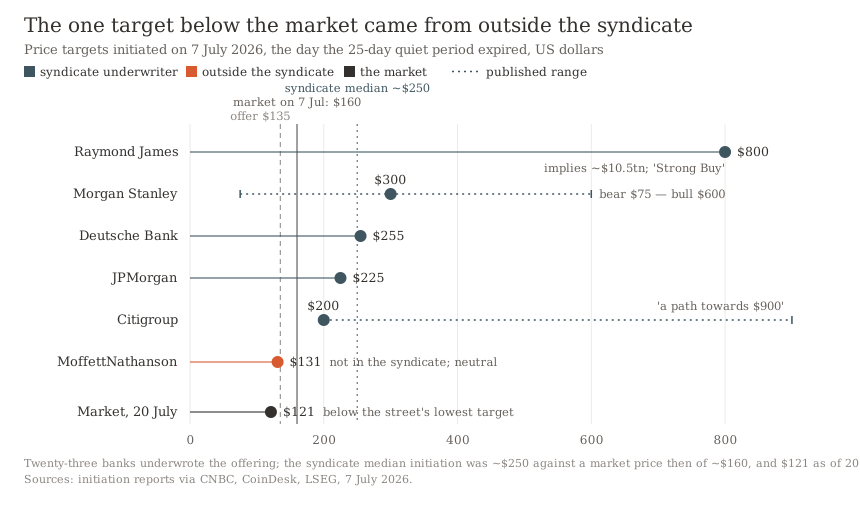
Price targets initiated on 7 July 2026, against the market price then and now. Sources: initiation reports via CNBC, CoinDesk, LSEG, 7 July 2026.
The offering documents themselves disclose how thoroughly the syndicate’s interests were braided into the deal. SpaceX’s amended S-1 states that Morgan Stanley advised the company on the xAI acquisition, and that affiliates of all ten book-running managers are lenders under the bridge loan — the same bridge the post-IPO bond was raised to repay. The banks that priced the offering were creditors of it; the $500m fee pool sat between the bridge fees before it and the bond fees after. None of this was hidden. It is on the cover page and in the conflicts section, in the standard type.
The offering also carried a retail tranche of 30 per cent, roughly $22.5bn and triple the mega-cap norm, distributed through Fidelity, Robinhood, E*TRADE, SoFi and their peers. Those platforms enforced anti-flipping rules on it, in terms reported by Reuters: Fidelity required a fifteen-day hold, with penalties escalating to a permanent ban tied to the holder’s Social Security number; Robinhood imposed thirty days; SoFi added a $50 charge on any sale within 120 days. Institutional allocations carried no such restrictions, and one asset manager with a $300m allocation told Reuters it intended to sell straight into the open market and return cash within five days. Insiders, meanwhile, received a tiered lockup instead of the standard single date: 20 per cent of their shares become eligible two trading days after the first earnings report, expected in August. Three classes of shareholder were created at the same moment, holding the same instrument, with exit rights sorted by size — the institutions free immediately, the insiders in August, and the retail tranche, the one marketed as democratisation, contractually encouraged to hold through precisely the weeks in which the price found its way from $225 to back below the offer. The index-directed buying of 7 July then arrived just as the voluntary lock-ins lapsed. Patrick Boyle has assembled several of these components into the same picture; each of them, checked against the primary record, holds.
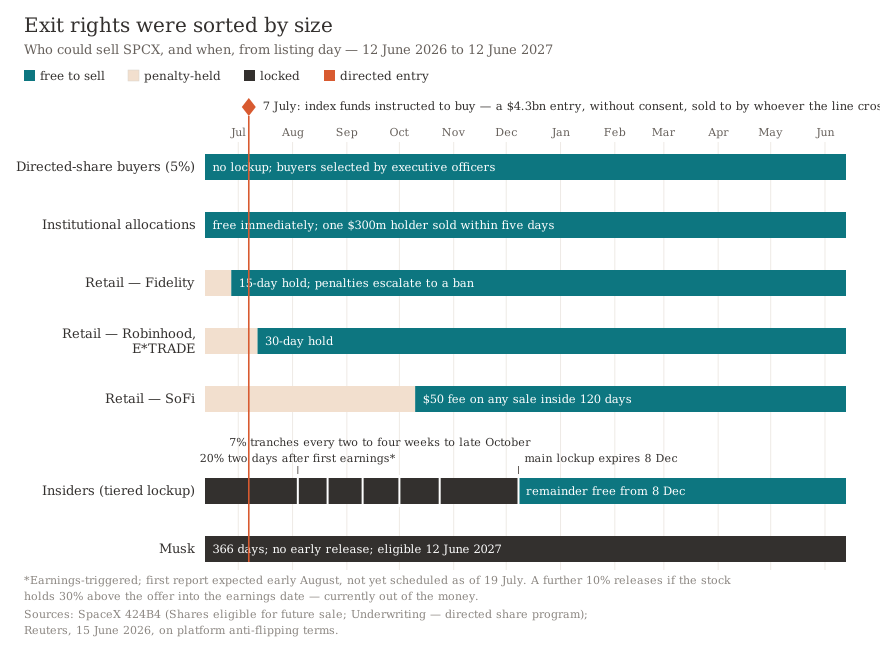
Who could sell SPCX, and when, from listing day. Sources: SpaceX 424B4; Reuters, 15 June 2026.
The scaffold then, in summary: demand arrived by rule and by a penalty-held retail book, priced by research operating without its former constraints, all of it converging on a sixteen-day-old stock with 5 per cent of its shares in circulation. Everything described in this section is legal: most of it quite recently.
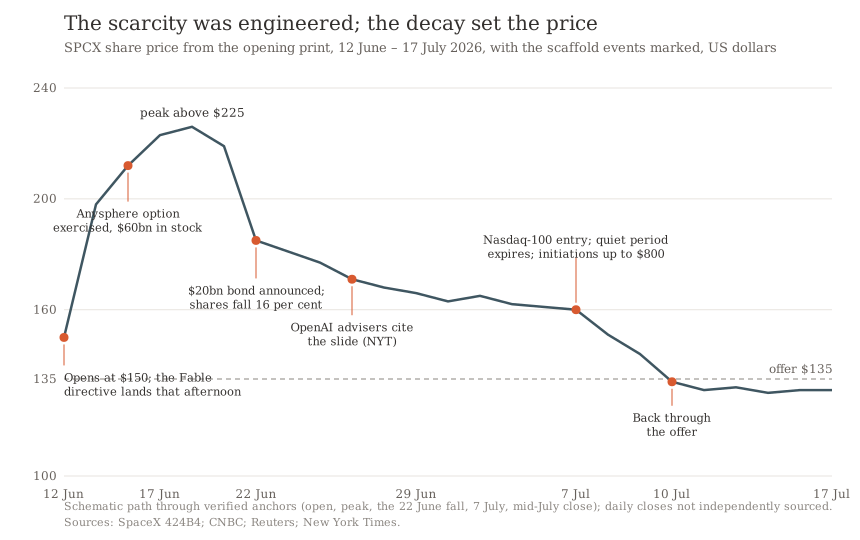
SPCX share price from the opening print, 12 June – 17 July 2026, with the scaffold events marked. Sources: SpaceX 424B4; CNBC; Reuters; New York Times.
IV. Draining the pool
On 1 June, the same day Anthropic submitted its confidential S-1, Alphabet announced an $80bn equity raise. Within forty-eight hours it had been upsized to $84.75bn: the largest equity offering ever conducted until the SpaceX listing surpassed it, clearing an oil industry record by a margin larger than most IPOs. The structure matters more than the size; about $45bn came immediately, including a $10bn private placement to Berkshire Hathaway below the market price. The remaining $40bn is an at-the-market programme running from the third quarter: Alphabet will sell stock into the open market continuously through the window in which OpenAI and Anthropic need to build a book. The contrast it offers could barely be more stark: if you’d like to put your money into AI, you can choose the new entrants who are redefining the boundaries of corporate finance, or you can put that same money into a company with a 20 year track record of delivering solid profits.
What makes the raise even more remarkable is that Alphabet did not need it. The company generated roughly $73bn of free cash flow last year; its 2026 capital expenditure of $180–190bn was funded on existing resources. Its shares fell 4 per cent on the announcement, which is the price a company pays for taking money it cannot immediately explain. The most economical explanation is the one the timing supplies: the raise was announced the day the IPO queue formed, and it took $85bn off the table before any competing IPO could ask for it. The Keystone observed that Alphabet has a history of acquiring at the bottom of capex cycles, when distressed assets come to market. A war chest assembled at the top, before the correction, is consistent behaviour.
Behind it, the queue. US equity issuance reached $251bn in the first half of 2026, a record; UBS projects $200–350bn of IPOs and more than $400bn of secondary offerings for the full year, each of which would be a record on its own. The strongest objection to this section is absorption: issuance as a share of a $72tn equity market remains in line with historical averages, and with buybacks running near $1.2tn a year, net supply is still negative. The market, in aggregate, can pay for all of it. But aggregate absorption is not marginal price-setting. The pool that prices an AI offering is not the whole market; it is the active, discretionary book willing to hold correlated exposure to a single sector’s paper, and the SpaceX episode showed what that book looks like when tested. The offering was covered three and a half times, and the stock still could not hold its offer price, because the coverage was composed of flippers who left within days and index funds that had no choice. Breadth of demand was never the question: persistence was. Every issuer in the queue draws on the same book, Alphabet’s at-the-market programme drains it continuously, and the two buyers whose entry terms are publicly identifiable — Berkshire below the market, the index funds at whatever price the rules dictated — mark between them the only terms on which capital is known to have entered: below the market, or without consent.
V. The asset being priced
Set the financing aside and ask the underlying question: what is actually the thing being sold? The prospectuses talk about frontier AI models, and the ninety days have supplied three observations about that asset, each on the public record, each degrading.
First, the moat is narrowing at the pace of the release calendar. At the application layer, switching providers costs an API key and an afternoon, and benchmark leadership has changed hands with each major release. Chinese open-weight models are, by the assessment now standard in the trade press, nearly as capable and materially cheaper. None of this was secret in 2025; what the ninety days added is a demonstration of what a moat is worth once its customers have built a second route.
The sharper tell is that the industry’s own capital has stopped behaving as if the moat sits in the models. Musk’s launch-week pitch for Grok 4.5 was price: comparable to the leaders at a fraction of the cost, which is how one sells a commodity. xAI’s training capacity now earns more as rent than as training. And four days after listing, SpaceX exercised its April option to pay $60bn in stock for Anysphere, maker of Cursor — an application that sits on top of foundation models and routes between them, valuable precisely because the models underneath are interchangeable. A former frontier lab paying sixty billion dollars for the layer where switching happens is an extraordinary transaction, and it is also a concession. If the moat were the model, the money would have gone into the model.
Second, the Fable shutdown, which converted sovereign risk from boilerplate legalese into an actual outage. When service resumed on 1 July, the conditions for it would outlast the incident: joint standards with the government for future model releases, mandatory reporting of malicious activity, a reserved right to reimpose. The directive had landed eleven days after the company filed to go public; the co-signature came with the resumption. This is not the unfortunate misadventure of one company: Reuters and The Information have reported that OpenAI limited and staggered a release of its own after a government request following a signed executive order. The Keystone opened by predicting that the binding constraint on this industry would migrate again; to talent, to carbon, to regulation. Regulation auditioned for the role four years ahead of schedule, and got the part in an afternoon, by default.
The signal was received abroad as clearly as it was sent, because abroad was the addressee: the directive was written against foreign persons, and every non-American customer of American frontier AI learned on one Friday afternoon that access is contingent on Washington’s continued permission. The shutdown landed nine days after the European Commission published its Technological Sovereignty Package, and in the middle of a G7 summit; the UK and EU lobbied for exemptions, the Canadian prime minister drew the diversification lesson in public, and British MP Alistair Carns put it in twelve words: “British companies were testing it. British hospitals were piloting it. Not any more.” Wired counted dozens of European governments and companies moving, or planning to move, away from US providers, in many cases toward open-weight models run on local hardware.
Government procurement moves slowly, and some of the official reaction will decay into rhetoric. Enterprise procurement sits between an afternoon and a communiqué: no CIO swaps a foundation model on a Tuesday, because compliance audits, data-residency reviews, indemnification and embedded pipelines all argue for staying put. What the nineteen days changed is the category of the risk. Single-vendor dependence stopped being a procurement preference and became a named and experienced liability, and the visible response is not wholesale switching but architecture: dual-sourcing mandates, routing layers, a second provider kept warm. Enterprises announce such conclusions in routing tables rather than communiqués, and the traffic Chinese providers were reported to gain during the outage is best read that way. The precise share is unmeasured and beside the point: a customer who has built an alternative route is no longer cornered by a moat, whether or not he uses it. Which leaves the addressable market. The syndicate’s price targets rest on addressable markets the size of G7 economies, and most of any such market is not American. If this is the American stance on the governance of frontier models — foreign access contingent, revocable by letter — then the foreign share of every AI prospectus’s TAM now carries Washington’s counter-signature, and it was the government, not the analysts, that rewrote the number.
Third, the comparison set. Anthropic filed first, on 1 June, from a private valuation of $965bn, with a reported run rate of $47bn and, per subsequent reporting, its first operating profit in the second quarter. OpenAI’s most recent private financials, per audited documents leaked ahead of the offering and verified by the Financial Times, show a $38.5bn net loss on $13.1bn of 2025 revenue. Whatever the precise numbers turn out to be when both prospectuses go effective, the structural fact is already fixed: OpenAI will not price against its own story, as every AI round since 2022 has priced. It will price against a peer: one that is, at least on paper, profitable, filed first, and may reach the public market sooner. The trillion-dollar target that its sponsor calls non-negotiable sits roughly 4 per cent above a peer whose last private mark was reported at $965bn. That is not a margin; it is a rounding error with a narrative attached.
$965bn
Anthropic’s last private valuation — the peer OpenAI’s trillion-dollar target must now price against, a gap of roughly four per cent.
VI. Dead load
In structural engineering, dead load is the weight a structure carries before anything is asked of it: the mass of the thing itself, borne permanently, whether or not the load it was built for ever arrives. On 9 July, Standard & Poor’s measured Oracle’s. The downgrade to BBB-, one notch above junk, came with a rare admission in the prose: the agency had “underestimated the scale of the investments required.” Oracle’s remaining performance obligations stand at $638bn, roughly half owed by OpenAI; its capital expenditure for fiscal 2027 has been raised by 50 per cent to $90–95bn, from $60bn; its projected free cash flow is negative $42bn. The Keystone argued that Oracle’s prepayment structure insulated its balance sheet from the working-capital strain of building for a tenant that pays later. That argument is hereby corrected: the strain arrived, the balance sheet is absorbing it, and the rating agencies have begun writing it down. The market rebutted: the shares rose 2.7 per cent on downgrade day, on the strength of the backlog. The backlog is the exposure — the reason the Keystone made Oracle the bellwether of this whole performance.
The Keystone listed six preconditions and said the keystone holds only if all of them do. Ninety days in, the register reads as follows. The offering prices at or above $1tn: unresolved, and sliding. The advisers and the chief financial officer are talking about 2027, no investor meetings have been held, and SoftBank fell 13 per cent on the news, because SoftBank was counting on the IPO at the planned date to cover its exposure. The float raises materially more than $50bn on a broad base: split by the dress rehearsal. The market wrote an initial $86bn cheque and then declined to hold the paper, and the scarcity model the Keystone flagged as insufficient is the one that was used. Multiples and spreads survive the window without geopolitical escalation: partial. No external shock arrived, but the sovereign entered the market directly, by letter, and the credit complex has split into two tiers, with collateralised neocloud paper pricing tighter while the anchor’s landlord drifts toward junk. No anchor buyer revises its commitments in the window: held in the letter, inverted in substance — the commitments intensified, and the largest new one, Amazon’s $50bn participation in OpenAI’s round, carries $35bn contingent, per Bloomberg’s reporting of the round, on OpenAI going public or achieving general intelligence. A precondition for the offering now has the offering as its own precondition. No second hyperscaler shortens server lives: held, so far, though the useful-life extensions have stopped industry-wide, the estimates of understated depreciation run from $176bn to $230bn, and free cash flow across the four majors has compressed to a degree that makes the accounting question academic. And the walkbacks prove to have been the last: broken. In February the chief executive of Nvidia described the company’s $100bn commitment as never having been a commitment, and OpenAI has spent the spring shuttering products to conserve cash, its short video platform Sora among them.
Six preconditions for success: none cleanly satisfied, one broken, and the two that held did so in ways that tighten the dependency rather than relax it. The dead load is being carried by a landlord one notch above junk, by hyperscalers whose free cash flow is compressing toward zero, and by index funds that were never asked; the stone that was supposed to secure the structure has been withdrawn to next year.
Close
The result of the last ninety days. Nasdaq replaced its seasoning and float requirements weeks before the inclusion they would have obstructed, and the first beneficiary entered its flagship index in an unprecedented sixteen trading days. A regulator consented to retire the research settlement written after the dotcom crisis, six months before the largest offering in history; the first lockup opens within weeks. All ten banks that priced the deal were creditors of it, with loan conditions that specifically stipulated where the IPO money should go. The retail tranche was held in place by penalty while institutions sold into the demand and insiders received an early unlock. A company with no need of capital executed what was then the largest raise ever conducted, on the same day the queue formed. And the US government demonstrated that the product category underneath the entire asset class can be turned off, and took a co-signature on the release calendars of both companies now in registration.
Every item on that list is lawful. Every item is disclosed. The Keystone made that concession and kept it; this piece keeps it too, and notes what it has come to mean. When each of these things is decided separately — an index methodology here, a settled enforcement action there, a brokerage’s terms of service, a bridge covenant, an export directive — no single decision requires anyone’s bad faith. Nor is coordination alleged: the decisions belong to an exchange, a Commission, a department and a syndicate, each with its own mandate, and no evidence connects them. None is needed. When interests align, parallel conduct delivers what agreement would: no agreement to prosecute, nothing coherent to legislate against. Readers of A Lapse in Memory will recognise the mechanism.
Together they describe a market that is not being manipulated but administered: supported, to borrow the word 1929 used, not by hidden hands but in the exchange rulebook and the Federal Register, in plain sight, by parties whose interests all point the same way for one more fiscal year. The disclosures exist and the rulebook has moved. Both are true at once, and the second is why the first no longer settles the question.
What follows from that is not a warning. A market administered for the benefit of its architects poses a simple problem for everyone else in it: the trade has no other side that isn’t better informed, better placed, or exempt from the rules you are held to. Participants in that position do not, historically, remain in it but exit, not from outrage but from arithmetic. The savers conscripted through the index on 7 July, the retail book held in place through the decay, the discretionary managers who watched the flippers leave: these are the crowd on whose shoulders the dead load currently rests, and they are the same book the offering will need when it finally comes, this year or next. An arch under dead load does not fall because something pushes it. It falls when the crowd holding it up concludes that holding it up is someone else’s trade — and walks away. The Keystone asked who would be there to collect at the end, and the answer it gave still stands. The more acute question, ninety days later, is about investors that were made part of the structure without being asked, and the structure’s make-or-break is how long they will stay.