1. The problem
Ford is putting engineers back into jobs that were given to software years before. Over the past three years the company has put roughly 350 of them — rehired, newly hired, or promoted — into vehicle quality roles, replacing the AI-based quality systems that failed to catch what they were installed to catch. The head of Ford’s vehicle hardware engineering has said the company assumed that introducing artificial intelligence and feeding it the design requirements would be enough. Ford spent much of the 2020s as America’s most-recalled automaker. It is now paying experienced engineers to do work the software was bought to eliminate.
Ford is only early. Gartner predicts that half the companies that blamed AI for customer-service cuts will be rehiring for the same work by 2027. Its own surveys suggest four in five of those cuts were never about AI at all. They were ordinary cost-cutting posing as a technology story, because that reads as strategy and cost reads as an apology. And the rehired roles, Gartner predicts, will come back under different job titles, so the work returns while the record of the mistake does not.
There is a single problem underneath. Most large organisations are now run by people who cannot check whether the claims behind their biggest decisions are true. Not because they are unqualified, but because the rules they operate under make checking unnecessary and dissent expensive. The one skill that could tell truth from confident nonsense, domain expertise, appears on none of the charts they steer by. So when that skill gets cut — and it gets cut precisely because no chart will miss it — nothing on the dashboard moves. The organisation loses its ability to evaluate claims, and with it, the ability to notice the loss. It finds out years later, the way Ford did: in the warranty data.
The piece is about where those rules came from, what they did to one company over twenty years, and what it would take to undo them.
2. How we got here
The rules have a birthplace and it is, not entirely by coincidence, the Ford Motor Company. In 1946 they hired ten officers out of the US Army Air Forces’ wartime statistics operation to run a car company they knew nothing about, purely by the numbers. The group became known as the Whiz Kids, and for a while it worked: measurement genuinely beat the seat-of-the-pants management it replaced. Their leading figure, Robert McNamara, rose to the presidency of Ford and then to the Pentagon, where the method’s failure mode eventually acquired his name. The McNamara fallacy: decide only on what can be measured, and everything that cannot be measured does not exist.
The business schools scaled this method into a degree. The MBA’s core exercise, the case study, asks the student to render confident judgment, at speed, on an industry encountered forty minutes earlier. That is not a caricature; it is the training, advertised openly. The product is portability: the promise that management is a discipline independent of the thing being managed. Domain-independence is not a defect: it is the feature it sells. The consultancies then finish the course, where a junior consultant learns that the recommendation surviving review is the one built entirely from what the client’s boardroom can verify. By the time this person holds an operating role, one lesson is bone-deep. Complying with the numbers is free. Explaining a deviation from them is expensive.
Put a manager trained this way in a room with a domain expert, and watch what the rules do. The board rightly mistrusts experts, because expert agendas are real. The engineer asking for another year of development also runs the budget that year would fund. The trouble is that the true objection and the self-serving one are in the same sentence. “We cannot build this at that cost” is correct engineering and territorial defence at the same time. A manager who cannot check the engineering can only judge the speaker, so the objection is discounted. That is not stupidity; with nothing else to go on, it is the rational move. Meanwhile the manager’s own agenda — career, defensibility, the next meeting — never gets discounted at all, because those interests are in the same currency as everyone else’s in the boardroom.
What fills the gap left by expertise is a number. Any number will do, because a single metric can be made to mean anything, with the right context: a margin figure can stand for risk, for discipline, for ambition, for strategy, depending on who is holding it. In 1997 the research firm IDC forecast that systems built on Intel’s new Itanium processor would be selling $38bn a year by 2001. The chip arrived late, systems sales peaked at $4.5bn only in 2008, but nobody at IDC suffered because the forecast had already done its job. It was a permission slip: a figure that let a preferred decision be filed as one properly evaluated. The boards of 2025 filing cost cuts under an AI strategy were holding the same instrument.
And once the number is installed, there is no appeal. Above the board sit investors; above investors, the market. Each layer up can read less of the actual claim than the layer below it, until at the top the entire question resolves to a single bit: make number go up. Computer science named this condition back in 1968, when Edsger Dijkstra argued that the GOTO statement was harmful. That wasn’t because it caused any particular bug, but because source code full of jumps could no longer be understood by reading it. The metric-run organisation is a stranger case, because it can still be read: the experts read it every day, with usable accuracy; they are simply not in the escalation path. The code is being read, but the conclusions go nowhere.
That is the whole machine: expertise discounted for good reasons, a number replacing it, deviation comes at a price and compliance is free, no appeal above. Every part is locally reasonable.
3. What it costs
In June 2006, Intel sold its ARM division, 1,400 people building the processors inside most smartphones then made, for $600m to focus on x86, the architecture inside PCs and servers. Within that same year, Apple came asking about a processor for a phone it had not yet announced. Intel said no, and the reason it said no is the machine working exactly as designed: Apple’s price was below Intel’s forecast cost. Paul Otellini, Intel’s chief executive, on his way out in 2013: “I couldn’t see it. It wasn’t one of these things you can make up on volume. And in hindsight, the forecasted cost was wrong and the volume was 100x what anyone thought.” On the numbers in the room, no was the correct answer, and nobody in 2006 could prove a forecast error of that magnitude. More importantly, no was free, while yes needed a case built on an unprovable number, argued to people who could not check it. Otellini named the format himself: “while we like to speak with data around here, so many times in my career I’ve ended up making decisions with my gut, and I should have followed my gut. My gut told me to say yes.” That is usually read as regret, but read it as procedure: he had the right answer, in the one format the rules could not accept as a filing.
Every step that Otellini describes is defensible: real margins, best-available forecasts, hostile economics — all true. When every step is defensible and the destination is ruin, the mistake sits upstream of the steps, in a category nobody could challenge. “Focus on x86” defined Intel’s core business as an instruction set, when the thing that actually made Intel unbeatable was its manufacturing flywheel: volume funds process learning, learning delivers the best factories, the best factories win everything else. Selling the phone-chip division and refusing Apple were the same act performed twice: selling the volume. And no one in the room could question the category, because the category was the room’s own benchmark.
Then came the vindication. Intel posted all-time records in 2010 and again in 2011, and spent $14bn buying back its own shares that year, ten times the prior year’s total. For half a decade, every instrument its board possessed confirmed the 2006 decisions while the consequences incubated in a market the instruments were never built to see. The proxy does not just fail to warn: it celebrates the wrong win.
The warning existed all along, running through the one channel that never files an objection: the customers. In 2015 Amazon paid about $350m, a rounding error next to Intel’s buyback budgets, for a small chip-design firm, and four years later published the result: its own server processors, launched with a claimed 40 per cent price-performance advantage over the Intel machines they replaced. This was a replacement project from the outset — if only to squeeze better terms from the supplier it was leaving. A customer had evaluated Intel’s claims in public, with numbers, and acted. Apple moved the Mac to its own chips. Microsoft and Google followed, and Google’s internal systems were running on its new architecture before the chip even had a public name. The announcement of a defection is a lagging indicator of a defection already executed. Intel’s data-centre revenue kept growing through 2020, then stalled, then fell by a quarter in 2022. Not all of that was defecting customers; a pandemic hangover, a resurgent competitor and the swing of budgets toward AI chips all pushed the same way. But the sequence is the point. The signal ran through the customer channel for five years while the dashboard reported records.
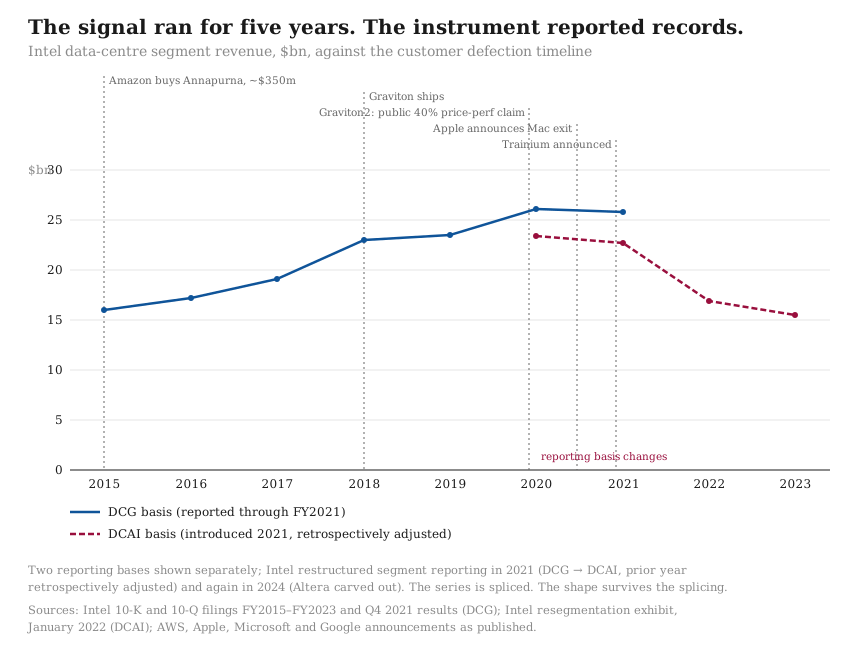
Intel data-centre segment revenue, $bn, against the customer defection timeline. Two reporting bases (DCG to 2021, DCAI from 2020) shown as overlapping series. Sources: Intel 10-K segment tables, FY2015–FY2023; Intel resegmentation exhibit, January 2022.
Two complications cut against this story. First: expertise is not foresight. Intel’s worst engineering disaster, the years-late 10nm factory process, was diagnosed correctly and in public by its own chief executive while it was happening. It was ruin anyway. Judged claims can come out wrong; the difference is that unjudged ones cannot come out at all. Second: experts defend dead ideas with the same confidence they bring to live ones. The telephone industry’s engineers spent the 1990s armed with flawless measurements proving this Internet thing could not work, and the generalists who overruled them by reading a cost curve were right. Domain expertise is a model, and models age. What checking buys a room is not being right. It is the ability to test a claim, and to have the argument at all. The telephone engineers lost their argument in the open. Intel’s board never got to hear its own.
The rules also decide who gets credit and decide it badly, because results lag decisions by years while the score is kept in business quarters. Intel put an engineer back in charge in 2021 and got the worst results in its history. The board removed him in 2024; then his factories came online and the record quarter landed under his successor, whom the market promptly credited. By the same lag, Otellini’s record years were partly his predecessors’ work maturing. The numbers that crowned one man and condemned another were the same instrument, read with the same delay. Nobody learns anything, because the scoreboard keeps paying the wrong people.
4. Digging out
The fix is not blaming the numbers people. Pat Gelsinger, the engineer who could not save Intel, was asked this year what went wrong: the company, he said, “started to be run by business people, as opposed to technical people”; “the bean counters, the finance people”, his interviewer offered, and he agreed. He is an interested party and it is the crude version. Engineers debased the one metric in their industry that tracked physical reality — the chip-generation names that ended up as marketing — and engineers authored the 10nm disaster. Swapping the suits for engineers just changes whose blind spots go unchallenged. The problem is not who sits in the chair. It is that the room cannot test claims, no matter who claims them.
So the repairs follow from the machine’s own parts.
First, wire the readers back into the decisions. Ford’s rehiring is the simplified version of this: buying back the capacity it cut. The full repair gives the people who can check a claim standing in the escalation path rather than being forced to sit in the peanut gallery outside it. One person in the room with the ability and the licence to say “that forecast cannot be tested, and here is what we would need to test it” changes what every number in the meeting is worth. I have watched the difference from the selling side. In the early 2000s I sold dark fibre: a gigabit between buildings for €2,000 a month, to companies paying €500 for two overbooked megabits. Their engineers needed no explanation; the numbers spoke for themselves. But the engineers were rarely in the final decision, and renewing the incumbent needed no document while buying from us needed a case. The renewal only needed inaction.
Second, make the default action a case too. The regime’s deepest asymmetry is that deviation must justify itself while compliance never does. Symmetry is a one-line rule change: the renewal, the no, the do-nothing must state what they expect to happen, in writing, so that the safe option becomes a testable claim like any other. A refusal that predicts nothing can never be wrong, which is exactly why the machine produces so many of them.
Third, score decisions across their real lag, not the tenure of whoever announced them. Public markets will keep quarterly time regardless; the internal clock is the one a board controls. If results arrive five years after choices, then attach the choice to the outcome regardless of who is in the chair when it lands: in the record, in the post-mortem, in the pay. The alternative is what Intel got: a scoreboard that fires people for their predecessors’ decisions and promotes them for their predecessors’ repairs, so that the organisation can run the same experiment for twenty years and learn nothing.
Finally, know what you are buying. None of the above guarantees being right: the 10nm disaster was fully evaluated and still ruinous, and the telephone engineers were fully expert and still wrong. What it buys is the argument: claims tested in the open before the money moves, instead of after the customers have. That’s all. It does not appear on any dashboard, which is why it is always the first thing cut and the last thing restored, and why the companies now rehiring their engineers are paying the full price to learn what it was worth.
The catch is that these repairs need a decision-maker the machine has not already selected for compliance — and selection is what the machine does.
Until the rules change, the old ones keep operating. MBAs are, by and large, highly intelligent and expensively educated people fitting a position the org chart has drawn for them. Their training — the school, and in many cases the consultancy years that followed it — taught them that “comply” is infinitely preferable to “explain”, and the regime they operate completes the lesson. No is unfalsifiable too. A refusal generates no forecast to be checked, no deviation case to be measured against outcomes, no record that a decision was made at all. It is the one output of the machine that makes no demand on the capacity the organisation cut, which is why it survived the cut. In a room where every deviation needs a case, and every case goes to evaluators who cannot evaluate it, the safest word in the language is no. And saying no requires no domain expertise at all.