1. The reset
On 19 May 2026 the UK transport secretary told the House of Commons that HS2 would cost between £87.7bn and £102.7bn to complete. The railway was tabled in 2010 at £15.8bn to £17.4bn. The northern legs are gone, the top speed has come down from 360km/h to 320, and the first train between Old Oak Common and Birmingham Curzon Street is now expected somewhere between May 2036 and October 2039. London Euston, which was the point, comes later still. Sixteen years passed and another sixteen to go. An Act of Parliament, a hybrid bill committee that sat for years, a National Audit Office series thick enough to need the trolley, two cancelled legs, and a transport secretary at the despatch box explaining why there is no railway.
Set that against a datacentre campus. Epoch AI published a cost model in May 2026 for a one-gigawatt artificial intelligence datacentre: roughly $38bn of upfront capital expenditure, covering the shell, the power plant and the silicon, with servers accounting for about sixty per cent of annualised cost of ownership. That is a modelled total rather than a construction benchmark, and it should be read as one. The completed HS2 is worth about three of them.
A gigawatt campus is several data halls, a substation stepping down from transmission voltage, cooling plant and the water treatment to feed it, and enough on-site generation or contracted firming to ride through a grid event, spread across a few hundred acres. The continuous draw is comparable to a large nuclear reactor unit. Whatever else it is, it is civil engineering on the scale of the railway.
Three of those, then, for one railway. Sites at that scale are typically energised within a few years of announcement, on a planning application and a grid connection agreement rather than a statute.
Both are physical infrastructure: both consume land, concrete and steel, and both draw on grid capacity that is scarce — the datacentre more urgently than the railway. Both are also the sort of long-lived asset that a country builds when it is thinking about the shape of its economy in twenty years. One took sixteen years and does not exist. Campuses of that scale are going up across several jurisdictions, and nobody voted on any of them.
The instinct is to read that as a failure story about the railway: British delivery, British procurement, British indecision, but it is not. The question the comparison actually raises is which of those numbers is actually the large one, and that turns out to depend entirely on what you set it against.
2. What a government gets to decide
The headline is the wrong quantity. The United Kingdom’s total managed expenditure runs above £1.2tn a year, and set against that a $38bn campus is a rounding error. But almost none of £1.2tn is a decision. It is pensions legislated decades ago, health spending driven by demography, debt interest set by the gilt market, and departmental settlements consumed by pay awards that no minister negotiated. A government arriving in office inherits nearly all of it.
The quantity that matters is the change a government makes against what it inherited. That number is not published, but it can be built, because the Office for Budget Responsibility scores every measure at every fiscal event and publishes the lot as a database. If you take the parliament elected in December 2019 and dissolved in May 2024, nine fiscal events fall inside it, from Budget 2020 through to the Spring Budget of 2024. Add up all spending measures across the five years and the total is £680.8bn.
Most of that is not a decision either, and the exclusions are where the work is.
Covid accounts for £290.2bn — furlough, the self-employment scheme, Bounce Back, test and trace, vaccines, the line the OBR calls virus-related public spending. Energy support accounts for a further £68.2bn: the price guarantee, the bill relief scheme, the council tax rebate. Both were responses to exogenous shocks, decided in weeks, and both prevented wider economic disruption rather than building assets. The Treasury and the National Audit Office treat them as separate envelopes, which means the boundary is theirs rather than mine.
A further £160.2bn is accounting, not a decision about what the state should do so much as a decision about how much of an existing thing to buy — and one the receiving department cannot redirect, because it is absorbed before it arrives. The Institute for Fiscal Studies has documented departments absorbing £11bn to £12bn of unbudgeted pay pressure inside fixed budgets across 2022-23 and 2023-24, and being asked to find a third of the 2024-25 awards, £3.2bn of £9.4bn, from within. An envelope a department must spend on a settlement it did not negotiate is not discretion.
The rest of the accounting layer is reclassification, and one line in it is the most tempting number in the whole database. Budget 2020 scores the cessation of EU contributions and retained customs duties as a spending reduction of £42.3bn across the parliament — the largest single movement in the residual, and a headline waiting to happen. The OBR had been holding those savings inside annually managed expenditure on a fiscally neutral assumption; the March 2020 forecast removed the assumption because the money had by then been captured in departmental plans. The £42.3bn saving and the £136.2bn envelope increase booked at the same event are two halves of one reclassification.
What survives all of that is £162.3bn over five years. Call it £32.5bn a year, across every department, and it is the answer to the question of what a British government actually gets to decide.
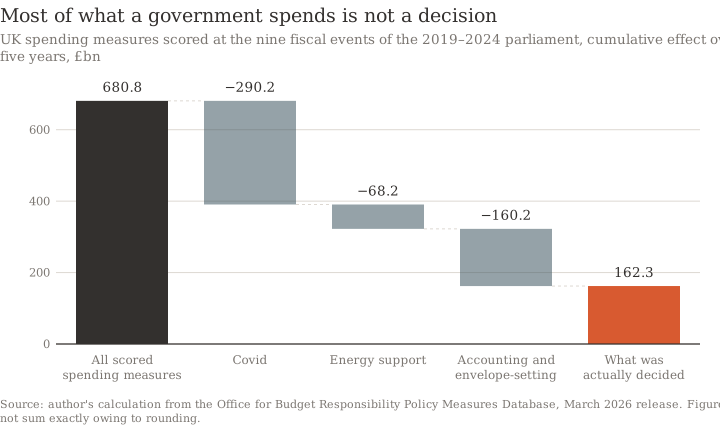
The decomposition drawn: £680.8bn of scored spending measures, less Covid, energy support and envelope-setting, leaving £162.3bn of actual decisions across five years.
To be clear: this is a G7 economy with an eighty-seat majority and a full five-year term. The constraint is not political weakness, and it is not fiscal capacity either — the same government found £358bn between two emergencies. The capacity to respond is intact, but the capacity to decide is what has gone.
Other countries publish similar budget numbers, all with slightly different methods, so the comparison is a spread rather than a series. Italy’s is the sharpest. The legge di bilancio consumes the whole Italian autumn: thousands of amendments, several hundred accepted, substantial rewriting in the Senate, confidence votes in both chambers, and a final margin of 216 to 126. The 2026 budget mobilises about €22bn, and it is almost entirely self-funding. The Netherlands publishes the cleanest instrument of the lot, since the planning bureau costs each coalition agreement against a baseline. Rutte’s third cabinet reached a net increase of €14.5bn a year by the end of its term, and the current agreement reduces spending against that baseline rather than raising it. Canada’s Budget 2025 sets out CAD 140.9bn of new spending against CAD 51.2bn of offsetting savings, leaving CAD 89.7bn net across a five-year plan, or CAD 125.6bn once policy actions taken before the budget are added in.
Germany does not belong in the same column at all. Its €500bn infrastructure and climate fund is a credit authorisation rather than scored expenditure, and it sits under a constitutional court that has voided arrangements of this kind before. We will have a closer look later.
Across the five, discretionary capacity lands somewhere between roughly half a per cent and one and a third per cent of national output. That is a range observed in five states with five different fiscal architectures and five different definitions. It is tight enough to settle the question the railway left open. The UK is not the outlier in that range, it is the median.
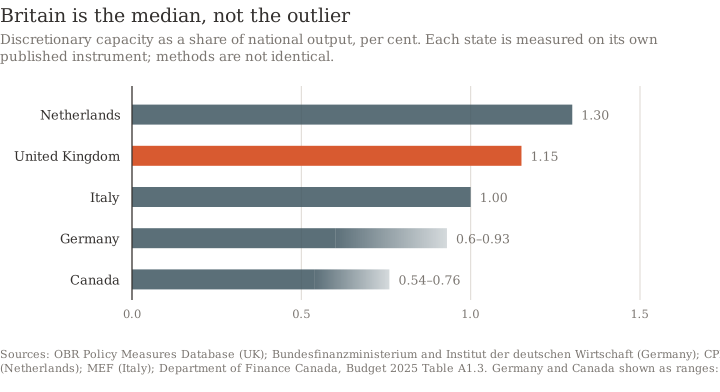
Discretionary capacity as a share of national output across five states. Germany and Canada are shown as ranges because their published instruments do not resolve to a single figure.
Which gives the comparison its proper shape. One gigawatt campus at $38bn is about £29.9bn. A British government’s entire annual capacity to decide anything new, across every department, is £32.5bn.
One campus is one year. The annual discretionary spending of a G7 country and the single project capex of a large corporation run to the same number.
3. What the state has left to hold
The obvious answer to a shortfall in spending capacity is that spending is not the primary instrument of government: a state that cannot outbid a datacentre can still regulate one, and the regulatory instruments have been sized correctly. That is true, and it is where the argument gets interesting, because the sizing turns out not to be the binding constraint.
The Digital Markets Act is the most carefully calibrated corporate penalty regime the European Union has written. Fines run to ten per cent of worldwide turnover, twenty per cent for a repeat infringement. Apple’s net sales for the year to September 2024 were $391bn, so the instrument available to the Commission was worth about $39bn. In April 2025 the Commission issued its first non-compliance decisions under the Act and fined Apple €500m. Meta got €200m. The compliance deadline expired sixty days later and the Commission said periodic penalty payments would not follow automatically, only after further analysis and an exchange with the companies.
An instrument correctly sized at $39bn, used at roughly one and a half per cent of its capacity, and then not escalated, is not a drafting failure. The legislature did the recalibration, wrote the number against the counterparty rather than against some historical sense of what a large fine looks like, and then the number turned out to be politically unusable. Which is a different problem, and not one fixable by statute.
A Lapse in Memory made a version of this argument about the memory manufacturers, where roughly a billion dollars of price-fixing penalties read as a rounding error against 2026 margins. The DMA case is worse: the ceiling for price-fixing penalties was low; here it wasn’t.
What has not decayed is permission. The state’s ability to refuse a licence or a grid connection still bites, and it bites absolutely, because no line item will put you past an export control or a merger prohibition. Two recent events show how that instrument actually operates.
Nvidia agreed to buy Arm from SoftBank for $40bn. The Federal Trade Commission sued to block it in December 2021 on a four-nil vote, with trial set for August 2022. The Competition and Markets Authority had opened a phase 2 investigation the month before, and the European Commission had an in-depth inquiry running. On 7 February 2022, six months before it would have argued the case, Nvidia abandoned the deal. Adobe agreed to buy Figma for $20bn and walked away on 18 December 2023, the day before its response to the CMA’s provisional findings was due, paying Figma a $1bn break fee on the way out.
Across two transactions and five jurisdictions, no regulator issued a final order. Nobody said no. The FTC’s own statement on the Arm outcome is careful about this, describing an abandonment rather than a prohibition and noting it as the first abandonment of a litigated vertical merger in years. In both cases the parties left because the probability of a no had risen far enough that the cost of finding out exceeded the cost of walking.
That tells you what kind of instrument permission is. It is not a sanction that gets applied. It is an option held by the state, and its value lies in the credible possibility of exercise rather than in exercise itself — which is also why it so rarely gets used, and why using it feels like a crisis when it happens.
None of which is obviously unprecedented, and the precedent is older than the Gilded Age. The States of Holland banned naked short selling on 27 February 1610, eight years after the VOC issued the first transferable shares, and a year after Isaac le Maire — a founding subscriber expelled from the board in 1605 — assembled a syndicate to sell stock he did not own and circulated rumours of shipwrecks to drive the price down. It is the first securities regulation on record. It did not hold; comparable bans had to be issued repeatedly for the rest of the century. Private capital dwarfed the discretionary reach of governments again in the age of the railway companies and Standard Oil, and the answer was the same in kind: antitrust, rate regulation, disclosure, the licensing state. Two things are different now: those instruments were built against capital that could not move, and a refinery or a trunk line stayed where it was put. And the graduated end of the toolkit is precisely the end that has stopped working, which leaves the state holding the one instrument the Gilded Age reformers regarded as a last resort.
The consequence is a state with two settings. It can stop a thing, at a political cost high enough that stopping is reserved for the exceptional case. And it can do nothing. What has gone is everything in between: the ability to condition, to price, to tax at the margin, to shape a transaction rather than veto it. Those are the instruments that work continuously and cheaply, and they are the ones that scale with the size of the counterparty. A fine that is a rounding error for the thing it seeks to prevent is an instrument that has stopped working.
4. The state as shareholder
Germany is the country that tried. In March 2025 the Bundestag amended the German constitution to create a special fund for infrastructure and climate neutrality with a credit authorisation of up to €500bn over twelve years. Amending the German constitution is ordinarily the work of years: this one took a lightning-speed twelve days.
The Bundestag election was on 23 February. First reading of the amendment was on 13 March, in a special sitting of the parliament the electorate had just replaced. The Constitutional Court rejected urgent applications on the 14th and again on the 17th, one complainant arguing that the timetable allowed no adequate opportunity to consider what was being changed. The vote came on the 18th: 512 for, 206 against, no abstentions. The Bundesrat assented on the 21st, and the amendment came into force on the 25th, the same day the newly elected Bundestag met for the first time.
There was a reason for this. In the new chamber the AfD and the Linke between them held enough seats to block a constitutional amendment: the outgoing parliament was the last one that could pass it.
And it is not fully settled. The Institut der deutschen Wirtschaft’s assessment is that the federal government is investing only marginally more than it otherwise would, because the budget’s headroom had already risen by about €22bn a year when defence spending moved from taxation to credit financing, and because the additionality test — a ten per cent adjusted investment quota — excludes credit-financed defence from its own denominator. About €24bn had actually flowed by the end of 2025. Above all, the instrument sits under a court with a recent precedent for voiding exactly this sort of arrangement: in November 2023 the constitutional court in Karlsruhe struck down the second supplementary budget for 2021, finding that the link between the emergency and the borrowing it justified had not been adequately reasoned, that emergency credit may not be set aside for later years, and that a closed budget year may not be amended after the fact. €60bn disappeared, the 2024 budget could not be adopted on schedule, and five Bundesländer found they had used the same device.
A state that amends its constitution in order to allocate, and then waits to hear whether it was allowed to, is a long way from being able to allocate.
For contrast, State Grid Corporation of China announced in January 2026 that it would invest ¥4tn (about €525bn) in fixed assets across the 2026–2030 plan period, a forty per cent increase over the previous cycle. One company, over five years, committed more than Germany amended its constitution to authorise over twelve. Fifteen new ultra-high-voltage transmission lines, cross-provincial capacity up by something like thirty-five per cent, and the stated purpose is to connect urban datacentre clusters to generation in remote clean-energy regions. No constitutional amendment, or even a vote in parliament, was needed.
The reason is not that China is unelected. Plenty of unelected states cannot do this. The reason is that the Chinese state sits inside the capital structure rather than outside it, through provincial financing vehicles, policy banks and the balance sheets of state-owned enterprises, and a shareholder can allocate where a regulator can only permit or refuse. This is centralised hypercapitalism rather than anything to do with communism, and the distinction matters because the mechanism, not the ideology, produces the speed.
The same asset class in a country that has to ask looks like Grain Belt Express: 5,000MW across four American grid regions, conceived nearly two decades before construction began, its federal loan guarantee terminated in July 2025, its developer fighting Missouri legislators over eminent domain for years. Operation is now targeted for 2029. The Federal Energy Regulatory Commission has around 1,500 staff and zero authority to site a power plant at all.
The Gulf holds the same instrument as China, but more openly. The Saudi Public Investment Fund had $913bn under management at the end of 2024; Mubadala deployed $15.2bn in the first half of 2026 alone, making it the most active sovereign fund in the world that half-year. One Abu Dhabi vehicle allocating at roughly the annual rate of a G7 government’s entire discretionary capacity.
Anyone who has done infrastructure business across both regions knows the practical form this takes. In a European market you identify the regulator, the permitter, the incumbent and the financier, and you manage four relationships that can and will disagree with one another. In the Gulf you identify one, because there is one. That is not a remark about culture, it is a description of where the balance sheet sits relative to the permission.
None of which means the shareholder state is particularly good at what it does.
The International Monetary Fund puts local government financing vehicle debt in China at ¥58tn and treats it as a serious risk to financial stability. China’s own executive director to the Fund put it at ¥44tn in a response published in the same document. Nobody knows, because the government does not publish the number, every figure is a reconstruction, and given that the state is shareholder, lender and regulator at once, the notion of debt is vague to begin with. What the Fund does establish is the sensitivity: a five per cent default rate across those vehicles would be equivalent to roughly a seventy-five per cent increase in banking system non-performing loans.
The Gulf record is no cleaner. PIF wrote down roughly $8bn on its gigaproject portfolio at the end of 2024. In May 2026 it emerged that NEOM had halted work on The Line, the 170-kilometre pair of mirrored skyscrapers once projected to cost over a trillion dollars, until at least after 2030; the population forecast had already been cut from 1.5 million residents to 300,000. The fund’s average annual total shareholder return runs at 8.7 per cent.
The Line is stopped and being redesigned, about five years into the project. HS2 is a railway that does not exist sixteen years after it was tabled and will take another sixteen. Neither state delivered the thing it announced. But one of them wrote off $8bn at a board meeting and redirected its strategy toward artificial intelligence infrastructure inside a year. The other needed much longer and much more money just to announce a delay.
The shareholder state does not fail less often. It fails faster, and it redirects faster, and the losses land on a balance sheet rather than in a chamber. Whether that is better depends on what you think the chamber is for.
5. Disclose, don’t cap
Bradley Smith, a former Federal Election Commissioner who founded the Institute for Free Speech in 2005, has spent his career arguing that all of this is the wrong way round. His position, set out in Unfree Speech and in testimony to the House Committee on House Administration in May 2023, is that campaign finance restrictions fail at what they claim to do while succeeding at things nobody voted for: entrenching incumbents, flattening campaign discourse, wrapping grassroots activity in compliance work, and putting distance between citizens and a professional political class. His first contention about the American regime is not that the limits are too high. It is that they are set too low to be meaningful. In the 2022 cycle the average Senate candidate raised about $13.8m and the average House candidate $1.8m, while an individual could give a candidate $2,900 and an independent expenditure had to be reported above $250. Against a $1.8m campaign, Smith’s argument runs, $250 is barely a drop in the bucket, and a threshold at that level cannot plausibly be preventing anybody from buying anything.
It is the same measurement failure, arrived at from the opposite direction and pointed at the opposite conclusion. Smith’s objection to a limit set too low is that it fails to catch quid pro quo corruption. The objection here is that it was never denominated in anything that could.
American law agrees with him. Writing for the majority in Citizens United, Justice Kennedy held that independent expenditures do not give rise to corruption or the appearance of corruption. Disclosure is the remedy; the identity of the speaker is not the state’s business.
On the British facts Smith wins. A constituency cap in the low tens of thousands, unenforceable once twelve months have run, alongside personal payments that fall outside the regime entirely, prevents nothing. At least, the American design puts the money on a form.
What it does not do is survive testing: Kennedy resolved an empirical question by assertion, and Matthew DeBell and Shanto Iyengar have since put the assertion to survey experiment. Independent expenditures turn out to be more likely to elicit an appearance of corruption than direct contributions, and contributions far below any legal threshold produce it too. Appearance does not scale with the amount, which is why a reported meal or a modest gift can generate more sustained coverage than a seven-figure transfer that broke no rule. The premise the ruling turned on does not survive inspection.
The two regimes end in the same place by different routes. Britain capped and America disclosed. Britain’s cap was written against the cost of reaching voters in a constituency; America’s disclosure regime was written against the assumption that visibility is itself a remedy. Neither was sized against the value of the decision the money is aimed at.
Neither is enforced, either, and for the same reason. Enforcement capacity is budgeted against the volume of transgressions and the size of the campaigns, never against what a transgression is worth to whoever commits it. Britain gives the police a twelve-month window on a twenty-thousand-pound number. The American commission is constituted with six members, no more than three from any one party, and four votes required to act, which makes deadlock a design feature rather than a failure of will. Both regimes are staffed and empowered on the assumption that what they are policing is the cost of a campaign.
An unenforced rule is worse than no rule. It does not restrain the money; it certifies it. Everything that passes through a regime nobody enforces acquires the standing of having complied, and the defence that no rules were broken becomes both unanswerable and true. The party that stays inside the limit pays the compliance cost. The party that goes round it collects the legitimacy.
The deterrent that survives falls on the wrong people. A rule enforced occasionally still binds anyone for whom the downside is total, and the generic shape of a personal sanction is total: a fine large enough to hurt, disqualification from office, the prospect of a criminal record. That is why agents keep meticulous accounts over every meal and postage stamp. Set the same fine against a balance sheet in the billions and it becomes a line item with a footnote, priced and forgotten, while the disqualification and the record have no corporate equivalent at all. One penalty is written; what it costs runs in inverse proportion to the resources of whoever is exposed to it, so the rules bind hardest on the people who were never the problem: those who took the trouble to understand what the rules required.
The same asymmetry runs upward. The Legg review of 2009 ordered 392 MPs to repay £1.3m of improperly claimed expenses. The Speaker resigned over his handling of it, the first forced from the chair since 1695; five members and two peers went to prison, and dozens more stood down. The ceiling the Commission declined to use on Apple was $39bn, about £30bn: roughly twenty-three thousand times the sum that ended those careers. One of those numbers reshaped a parliament. The other was politically unusable because there is no public scale on which it means anything at all.
Attention follows measurement, which is the other half of the trick. Overspending a constituency limit by a few hundred pounds is reported as a scandal, because it is countable, attributable and set against a published number, and a published number is what a story needs. Money that never enters the regulated quantity attracts no equivalent coverage, not because anyone conceals it but because there is no figure for it to breach. The regime does not have to be captured to produce that result. It only has to measure one thing.
6. Two options, and one of them is free
If the government decisions that remain are few, large and binary, they are also the cheapest things in public life to influence. There are two ways to do it, and only one of them shows up in any register.
The first is to buy an option on a politician, and it does not mean what it sounds like. Independent expenditure never reaches the candidate. It pays media buyers, advertising agencies, polling firms and campaign consultants, and the politician who benefits may not lawfully coordinate with the people spending it. No personal balance sheet moves. What moves is the probability that a particular person keeps their seat, or that somebody else acquires one. The option is the credible, standing availability of funding an opponent, and its value lies precisely in never having to be used. A threat that is not exercised costs nothing to maintain.
Nothing about this is new. Sector-level electoral intervention, funded by an industry rather than by a firm, hedged across both parties, has been standard practice in American politics for decades. The gun lobby built a version of it, and so did the realtors, the trial bar and the tobacco companies. The most durable versions were never single vehicles at all: influence exercised through a loose network of nominally independent committees is harder to disrupt than one organisation with a name on the door, and considerably harder to read off the paperwork.
What has changed is the documentation. Fairshake, the network through which the American cryptocurrency industry now intervenes in federal elections, is the clearest current instance because the structure is legible in the filings: one committee holds the money, one spends on Democrats, one on Republicans. Take the Republican-facing vehicle alone: its 2023 receipts came from Coinbase, Ripple Labs and Andreessen Horowitz at $1.5m each, with a $150,000 seed transfer from the holding committee. Through 2024 it took $54.4m in transfers from its affiliates and made $57.8m of independent expenditures. That is one of three committees, in one cycle, on one side of the aisle. Public Citizen’s analysis found that the network’s advertising rarely mentions cryptocurrency at all.
A disclosure regime is not built to capture this. Registers log transfers, and the worth of this instrument is that it sits there, unspent, and is known to. A Lapse in Memory found the same structure in a different market, where both sides benefit from an option that neither needs to exercise.
It also explains the shape: a favourable regulatory outcome benefits every firm in a sector, so any single firm paying for one subsidises its competitors, and the sensible response is a shared vehicle funded across the industry and hedged across the parties. That is why these things look the way they do, and why they persist across decades and administrations. The question is why so few industries bother. The answer is the second option.
In 2017 the Dutch government moved to abolish the fifteen per cent dividend withholding tax, in significant part to keep corporate crown jewels Shell and Unilever headquartered in the Netherlands. Public backlash killed the plan. Unilever left anyway in November 2020. In November 2021 Shell announced that it would collapse its dual share structure, move its head office and tax residence to Britain, and drop “Royal Dutch” from a name it had carried since 1907; the assimilation completed on 29 January 2022, and Shell’s own annual report records that Dutch dividend withholding tax no longer applied. The government said it had been unpleasantly surprised. The economic affairs minister spent that day telephoning party leaders to gauge support for scrapping the tax.
Britain did not outbid the Netherlands: Britain simply does not levy the instrument, which turns out to be the more desirable position.
Three years later the same state was on the other side of the same transaction. In January 2024 ASML’s then chief executive, asked about Dutch restrictions on labour migration, said the company would go where it could grow. By March the outgoing cabinet had a package on the table, and it wrote to parliament on the 28th setting out €2.51bn for talent, housing, accessibility and grid congestion around Eindhoven. The letter is unusually direct about what the money is for: in taking these measures, it says, the cabinet assumes that ASML will invest further in the Netherlands and will keep its statutory, fiscal and actual seat there. By 2025 the package was stalling on nitrogen consents, housing delivery and power shortages. Of the roughly 60,000 homes the region needs before 2030, 17,000 attributable directly to the programme, current delivery runs at about half.
So the Netherlands lost Unilever, lost Shell, paid €2.51bn to keep ASML, and then could not supply the grid capacity it had named in its own letter.
A refusal is only a sanction if there is nowhere else to go, and for capital that can be sited anywhere there is always somewhere else. That sorts the world into two kinds of firm. A stablecoin has no physical form and cannot be built in Jutland instead. Its regulatory treatment is decided in a legislature or not at all, which is why the sector built Fairshake and the datacentre operators did not need to.
Firms that cannot leave, pay. Firms that can leave, leave. A state facing the second kind is not regulating the capital: it is bidding for it.
7. The best politicians money can buy
Clacton, a coastal town in the UK, at the general election of July 2024.
Three limits descend, through a century of inflation uprating, from the Corrupt and Illegal Practices (Prevention) Act of 1883. A candidate contesting that seat could spend £20,660.72 on the short campaign. A political party could spend £54,010 attributable to the same seat. A registered non-party campaigner could spend £17,553 there. Every one of them is denominated in pounds spent inside one constituency during one defined window. The register of members’ interests, the fourth instrument, is denominated in transfers received by a sitting member.
Ahead of that election, a private individual gave Nigel Farage £5m.
Not to a campaign, and not to a party. To the man. Reform UK’s position is that it was a personal and unconditional gift. Whatever else it is, it is not an option on an opponent — the American structure works precisely because the money never reaches the politician, and this did the exact opposite. The payment did not appear in the register of members’ interests, the position taken being that it predated Farage becoming an MP. The Parliamentary Commissioner for Standards opened an investigation in May 2026. Farage resigned his seat on 7 July, which paused the investigation.
The procedural instruments reached no further. Essex Police were asked to examine whether the constituency limit had been exceeded in Clacton, and found the allegation time-barred, because suspected offences must be reported within a year and the year had run. One instrument could not see the transaction. The others could not reach it in time.
So much for the price. Every political party and registered campaigner in the United Kingdom, contesting all 650 seats in 2024, spent £94.5m between them, and that was a record. £94.5m to decide the distribution of £162.3bn in discretionary spending, and the freedom to regulate and permit. One payment, from one person to one politician, is 5.3 per cent of the entire national total.
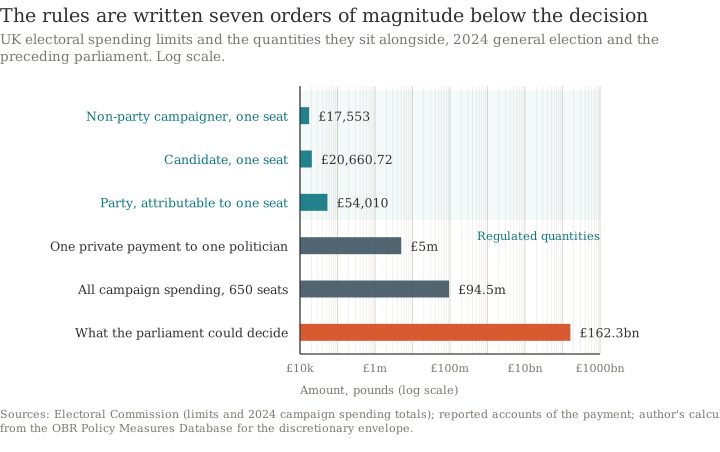
The regulated quantities and the quantities they sit alongside, on a log scale. The three electoral limits cluster at the left; the decision they bear on sits seven orders of magnitude to the right.
The old line about American politics is that the country has the best politicians money can buy. It is usually delivered as an accusation. Taken literally it is a valuation, and the valuation is unflattering to everyone in it. Against the discretionary capacity of the government they are competing to direct, and against the assets whose regulatory treatment they will determine, politicians are not expensive. They are conspicuously, structurally cheap — and nothing in the way any of this is measured registers that as a fact about the price.
8. Who can afford to refuse
Put together, that is the great mispricing. Government capacity is quoted against total managed expenditure, which is mostly not a decision. Political influence is priced against the cost of running a campaign rather than against the value of what the campaign decides. Enforcement is resourced against the number of offences rather than their value to the offender. Every one of those figures is correct. Every one is measured against a reference that stopped corresponding to anything, and nobody chose the moment it happened.
Nor is any of it hidden. The Electoral Commission publishes the limits and the returns, the OBR publishes every scored measure, Shell’s move is in its annual report, Apple’s turnover is in its 10-K, and the Clacton payment surfaced from the public record. There is no concealment problem here. There is a measurement problem, which is the more durable of the two, because a concealment problem has somebody to hold responsible.
Anything denominated in money can be absorbed. A fine is a number in a column, and a number in a column gets a provision, a budget line and a paragraph in the annual report. Apple reported $26.1bn of selling, general and administrative expense for the year to September 2024 — the line that already carries counsel, compliance and audit. The €500m the Commission levied is about two per cent of it. The largest penalty yet issued under the most carefully calibrated regime of its kind lands as a variance in the function that exists to absorb it. That is not deterrence failing at the margin. It is an instrument in the wrong category, because the question a monetary penalty asks is how much, and how much is the question the counterparty is better equipped to answer than the regulator. Litigating to delay an unfavourable ruling is standard procedure, and the incentive to outspend an enforcement budget across a decade is substantial.
The binary is the only thing left that cannot be provisioned for. There is no line item for a refused export licence. Nobody accrues against a blocked merger. A connection agreement that does not arrive cannot be settled at a discount in the fourth quarter.
The states that still have something to say between yes and no are the ones sitting inside the capital structure rather than outside it. Singapore’s holding company, Norway’s fund, a German Land on the supervisory board of a car manufacturer. That option is available to a democracy. Almost none have taken it.
The rest hold a permit, and a permit alone is worth very little. One state refusing a connection or a clearance loses the investment and keeps the refusal; the applicant loses a location and keeps everything else. The proportion runs against the sovereign, which is why the instrument mostly sits unused.
Aggregate enough sovereigns though, and the proportion inverts. A market of four hundred and fifty million people can refuse access on terms that cannot be routed around, and refusal then costs the applicant more than it costs the refuser.
Which is why the European Union occupies the position it does in the corporate account of the world. Not as an inefficient regulator, which it undoubtedly is, but as an adversary — the object of more sustained lobbying, more trade-diplomatic pressure and more genuine hostility than any national government attracts. The Commission fined Apple €500m against a ceiling of $39bn and then declined to escalate, and even that was read as an act of aggression requiring a response at the level of trade policy. Nobody spends that much energy on an instrument if it does not work. The hostility is the evidence.
Coordination between states is the only thing left that makes sovereignty mean anything.