In November 2025, Satya Nadella told the Bg2 Pod that Microsoft had a problem. Not the problem everyone had been expecting for three years — that chips were scarce, that NVIDIA’s allocation queue was brutal, that Jensen Huang held the industry’s roadmap in his hands. A different problem. “You may actually have a bunch of chips sitting in inventory that I can’t plug in,” the Microsoft CEO said. “It’s not a supply issue of chips; it’s actually the fact that I don’t have warm shells to plug into.”
This was an unusual thing for the most powerful technology company in the world to say on the record: Microsoft was planning a capital budget of $80bn for fiscal 2026, largely focused on AI. Yet here, its CEO was telling a podcast audience that the bottleneck had moved: it was no longer with the chip supply, but downstream toward the electrical plant and generation capacity that turns silicon into computation. In April 2026 Bloomberg reported that close to half of the planned US data centre builds for the year would be delayed or cancelled, not for lack of money or silicon, but for lack of the electrical backbone to energise them. Lead times that had run two and a half years in 2022 had stretched past four. American imports of high-power transformers from China had risen roughly fivefold over three years.
The constraint had inverted. And because it had inverted, a generation of assumptions baked into the industry’s financing structures had quietly gone out of date.
Consider the H100 chips that Microsoft, Amazon, Google and Meta bought at roughly $40,000 apiece during the 2023-24 allocation crunch. On the secondary market in early 2026 they trade at $14,000, and a newer chip, the GB200, delivers roughly fifteen times the inference performance per watt. If it was like any past market for previous generation production tools, H100s should be cheap and abundant. But plugged into a wall and running, they are nowhere to be found.
Developers cannot rent an energised H100 at any price. Holders of scarce energised capacity are pricing their H100 slice not against the value of the chip but against the opportunity cost of the socket, which is whatever a Blackwell would earn in the same place. The secondary-market price collapse is not a signal of abundance. It is a signal that a generation of silicon is being made obsolete by its successor before the prior inventory has cleared, on balance sheets that still depreciate it over five to six years as if nothing has changed.
The accounting divergence tells the story most clearly. In February 2025, Amazon shortened the assumed useful life of a subset of its AI servers from six years back to five, took $920m of accelerated depreciation, and named the cause in its annual filings: “the increased pace of technology development, particularly in the area of artificial intelligence and machine learning.” Meta, in the same quarter, extended its assumed useful life from three years to five and a half, capturing nearly $3bn of additional operating income. Both cannot be right about the same kind of asset.
This is not a story about AI as the next (or current) tech bubble. The technology is real, the demand is real, and the capital deployed — hundreds of billions by just the large US hyperscalers alone — is real enough to strain global non-silicon supply chains for transformers and the single-crystal nickel alloys used in gas turbine and jet engine blades. However, this is a story about what happens when the binding constraint on a boom migrates faster than the financing structures created to sustain it. In 2023 the constraint was chip supply. In 2026 it is electrons: the transformers, the interconnection queues, the gas-fired generation that turns silicon into computation. By 2030 it will likely have moved again: talent, carbon, regulation, or the financing structures most likely among them. The conventional capital markets were never going to pay for the gap between the three-month chip cycle and the three-year power cycle at this scale.
What filled the void is an architecture of commitments built around a single outcome: an OpenAI public offering, in the second half of 2026, at a valuation with no precedent in the public-market record. This piece argues that outcome is unlikely, and that the reason is structural rather than sentimental — a set of preconditions which, taken together, would require nothing short of a financial miracle. The question this piece takes up is what happens next: which of the structures built around the IPO fall apart when the miracle does not arrive in full, which survive, and, on the far side of the correction, who will own the infrastructure? That last question has a shorter answer than most commentary allows.
1. The inversion, and the accounting
Eighteen months ago, the binding constraint on AI infrastructure was GPU supply: the number of advanced chips NVIDIA, AMD and Intel (but mostly NVIDIA) could manufacture, allocate and ship. It is not the binding constraint today. NVIDIA ended its fiscal 2026 with $21.4bn of inventory on the balance sheet — more than double the prior year, and the largest absolute inventory balance in the company’s history. Some of that is work-in-progress, some is product waiting on sockets that haven’t arrived yet; disentangling the two exactly requires more disclosure than the filings provide. But Microsoft’s public acknowledgement that it holds GPUs it cannot energise makes the direction of travel unambiguous. The transformers and interconnection and generation capacity behind the silicon have not arrived.
The secondary market for H100 units tells a similar story. Clearing rates for rental-grade capacity are down roughly 60% from their mid-2024 peak. Refurbished-certified units have fallen from $42,000-$45,000 at the top of the cycle to $14,000-$16,000. Transaction volume has collapsed. But — and this is the part most observers miss — the market has not broken for want of demand. It has broken because holders of energised capacity have started pricing their H100 slice against the opportunity cost of the socket, not against the value of the chip. A GB200 delivers roughly fifteen times the inference performance per watt of an equivalent H100 rack, on the workloads that dominate deployed capacity, and by independent benchmarks substantially more on the largest workloads. Anyone allocating a scarce energised socket to new deployment will choose a GB200 over an H100. The physical H100 inventory sitting in warehouses is not failing to find customers; it is failing to find sockets.
For already-deployed H100s the picture is different but not reassuring. A chip that is already consuming its socket is evaluated on marginal revenue against marginal operating cost, and on average H100s still clear that bar. But energy costs span a wide regional spread, and H100 token revenue does not. In high-cost regions the business case for continuing to run an H100 is flat at best. The average break-even is twelve to eighteen months out at current trajectories; the market-specific break-even has in some geographies already arrived.
This is the cliff a five-year depreciation cycle does not capture. The asset is not depreciating toward a floor through normal use; it is being made obsolete at the socket layer by a successor chip that redefines the per-watt economics of every capacity decision. And it is worth being clear that this is the cadence, not a one-off. Each of the last three of NVIDIAs GPU generations has been superseded on a two-to-three-year cycle with roughly five-to-sixfold improvements in training performance and larger ones in inference. The fourth transition is already in production: NVIDIA’s Vera Rubin platform is scheduled for the second half of 2026, drop-in compatible with the existing Blackwell rack infrastructure, delivering approximately five times the inference performance. Jensen Huang has told investors mass production may arrive earlier. One industry analyst headline in January 2026 captured the situation precisely: “Vera Rubin obsoletes current AI iron six months ahead of launch.” The Blackwell capacity that current credit packages are being underwritten against is likely to be one generation behind the frontier within twenty-four months of full deployment. The depreciation argument is not an H100-specific argument; it follows from a roadmap that has compounded faster than any traditional depreciation schedule can accommodate.
The mechanical cause of the socket shortage is the power-delivery constraint. A GPU is useless until it has a socket, and a socket is useless until it has transformers stepping current down from transmission, interconnection approvals from the regional grid operator, and — for sites running through peak demand — dedicated generation, typically gas-fired. Each has a procurement cycle measured in years. Transformers for hyperscale campuses have lead times of eighteen to thirty-six months from the small number of qualified manufacturers. US grid interconnection queues sit at two to four years. New combined-cycle gas turbines ordered in early 2026 will not deliver electricity before 2029.
Physics doesn’t care about your strategic plan. The mismatch between a three-month procurement cycle on silicon and a three-year procurement cycle on everything downstream of it is what produced the inventory overhang visible in NVIDIA’s filings.
The accounting conventions that frame all this infrastructure on the hyperscaler balance sheets have not caught up. The three largest public cloud operators have historically depreciated server hardware on a five- to six-year straight-line basis: typical for servers and network equipment that remains economically useful even after year four. In the accelerated-compute generation, a frontier GPU is economically useful only until the successor generation reaches production scale. The gap in accounting between useful life and economic life is a direct overstatement of earnings: charges that should be taken now are deferred, improving operating margins in the hope that nobody will mind later.
Amazon was the first to act here, and the manner in which they did matters. In late 2023, AWS had increased server useful life from five to six years, adding an expected $3.1bn to 2024 operating income. The rest of the industry followed along behind it. Fourteen months later, in February 2025, Amazon reversed the decision for its AI-relevant fleet, taking the useful life back to five years and the income hit with it. The annual report named the cause explicitly: “the increased pace of technology development, particularly in the area of artificial intelligence and machine learning”. This specifically-AWS attribution has appeared in every subsequent quarterly filing.
The weight of this signal is worth dwelling on for a moment: AWS is not just one of three major cloud providers; it is THE firm that defined the modern hyperscale playbook that the rest of the industry has spent a decade copying. The move to a six year depreciation in 2023 was itself led by AWS, with Microsoft and Alphabet following within twelve months. The same accounting team that pulled the cohort into the six-year convention has now pulled itself back out, on the same fleet, citing the same workload. That is not conservatism. That is the bellwether recognising it had got the call wrong, at something close to lightning speed in accounting terms, on the asset class that now dominates its capex.
Microsoft, Alphabet and Meta have not followed. Their capital budgets — over $80bn combined for fiscal 2026, overwhelmingly allocated to GPUs — continue against the older convention. Meta has even gone in the opposite direction, extending assumed useful life from three years in 2020 to five and a half by 2025. There is something to be said for this in Meta’s position: its fleet skews more heavily toward inference than Microsoft’s or Alphabet’s, its workloads run on recommendation and ranking systems that have longer utility tails than frontier training models, and its open-weight strategy means it captures less direct AI revenue but gets more extended infrastructure utility. In this light, Meta’s GPUs genuinely depreciate more slowly because they are not being asked to do what Amazon’s GPUs are being asked to do. The counterargument here is that the socket-level opportunity cost applies regardless of workload — a Hopper inference rack’s marginal revenue still has to compete with a Blackwell rack’s marginal revenue, and the inference-per-watt differential is precisely where Blackwell’s advantage is largest. Meta’s position might be more defensible than the accounting convention the other three are carrying, but that defence is contingent on compute workloads that have not been stress-tested through a full generational cycle. The scale of the unrecognised charge across the cohort is straightforward to estimate. NVIDIA’s audited Data Center revenue across 2024 and 2025 totals approximately $315bn, of which NVIDIA discloses hyperscalers represented “slightly over 50%”. That implies roughly $160bn of NVIDIA hardware was added to hyperscaler books over the past two years, from NVIDIA alone. Adding networking, racks, power equipment and shell at the system level takes the base to at least $250-300bn. Against that base, a one-year reduction in assumed useful life would take $15-25bn of additional annual depreciation through the collective income statements. The question is no longer whether the correction comes, but whether the remaining three move in coordination with Amazon, or in succession behind it.
$21.4bn
NVIDIA’s inventory balance at the end of fiscal 2026 — more than double the prior year, and the largest in the company’s history.
2. The arithmetic of a stranded gigawatt
The depreciation problem sharpens when you look at the unit economics of a single data centre cluster on each of the three plausible timelines. As an example, let’s take a 100-megawatt cluster coming online in the first quarter of 2026, with an all-in capital cost of roughly $3.7bn (about 60% silicon, 40% power and shell), contracted on a five-year take-or-pay at current market rental rates to a single hyperscale-grade anchor tenant.
On-schedule and at full utilisation, which is a tall achievement in the world of data centre construction, the day-one net present value at a 10% discount rate lands at roughly +$0.25bn. A modestly profitable outcome on a massive capital base — which tells you the industry is running on thin per-cluster margins even when every assumption holds. A six-month delay in going live doesn’t just compress the margin; it reverses it. The first half-year of revenue is lost permanently (no catch-up against a fixed contract term), and the rental rate on what remains compresses by about 40% as Blackwell-based capacity comes online elsewhere during the wait. Day-one NPV falls to approximately −$1.70bn. A twelve-month delay erases the first year entirely, compresses the rental rate by around 60% on recovery, and takes day-one NPV to roughly −$2.52bn — more than two-thirds of the original capital outlay destroyed before the first invoice is issued.
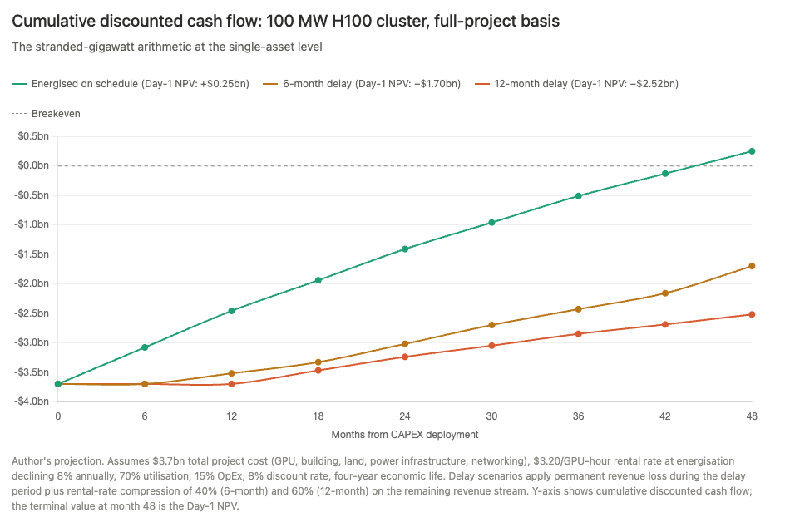
These are not edge cases: They’re the scenarios now typical for sites awaiting transformer delivery or interconnection approval in major grid regions around the world. The arithmetic is straightforward: a modestly profitable project on schedule becomes a catastrophically unprofitable project at a six-month slip, and a fully value-destroying one at twelve months. The cliff is steep because the key asset is depreciating physically and technologically during the wait while the revenue clock has not yet started.
This is before considering secondary-market dynamics for the underlying silicon. The cascade thesis — frontier chips drop to fine-tuning, then inference, then research — is real, but it only works if the secondary market clears at predictable prices. At present it is not. Refurbished-certified H100 units at the three-year mark sit at 30-40% of peak retail, broadly consistent with the five-year depreciation schedule. But the certified refurbished segment is the top of the secondary market and a sell price, not the mid-market buy price. Raw uncertified units clear at 20-25% of peak; transaction volume has collapsed. And each Blackwell ramp-up milestone resets the Hopper price before the prior inventory has cleared, because the socket-level opportunity cost keeps widening. The gap is going to get bigger before it’s going to get smaller.
3. The supply-side arithmetic
Concerns about the depreciation gap would matter less if the deployment timeline were flexible. It isn’t. The supply-side arithmetic for new power generation at AI-relevant scale does not support the announced demand. The forensic question is what specifically fails; the structural question, which the closing takes up, is who buys the wreckage.
The pool of gas-turbine manufacturing capacity — the dominant bridging technology for the 2026-2030 window — is effectively owned by three companies: GE Vernova, Siemens Energy, and Mitsubishi Power. Their combined capacity to deliver utility-scale gas turbines will be in the 50-60 gigawatt-per-year range by late decade. That is for ALL gas-fired generation globally, not only data centres. New orders placed today will not be delivered before 2028. NextEra has stated 2032 for newly-ordered equipment. GE Vernova’s late-2025 earnings call confirmed that its heavy-duty gas turbine slots are sold out through 2029. And the backlog is not a simple assembly-hall scaling problem; it is several tiers upstream, in the handful of foundries qualified to produce the specialised high-temperature turbine blades at the heart of these machines.
The competition for that foundry capacity is direct and concrete. The global commercial aircraft backlog sits at approximately 14,000 firm orders between Boeing and Airbus, each of which requires two to four high-bypass turbofans drawing on the same facilities. The global defence backlog, driven by the re-arming cycle across Europe and the Indo-Pacific, has produced an F-35 engine hot-section shortage that has grounded combat-ready aircraft at US bases through much of 2025. Aerospace, defence, and the AI-adjacent power build-out are now bidding against each other for the same constrained foundries, the same qualified metallurgists, and the same mine outputs. Aerospace and defence have the longer supply-chain relationships and, in the defence case, a sovereign backstop for the bid. The AI data centre constituency has deeper pockets but faces a buyer with a stronger claim.
The LNG part of the fuel supply has re-priced in a violent way: Iranian drone strikes on Qatar’s Ras Laffan export terminal on 1-2 March 2026 prompted QatarEnergy to declare force majeure on its entire output, temporarily removing roughly a fifth of global LNG supply and pushing benchmark European wholesale prices up 50% intraday. The follow-on missile strike on 18-19 March caused the permanent damage: two production trains and an ancillary facility structurally compromised, roughly 17% of Qatar’s export capacity — 3-4% of global supply — sidelined for a three-to-five-year repair timeline. European wholesale gas prices have settled above €60/MWh with futures trading persistently above the pre-strike range. The fuel that was supposed to bridge the AI build-out has become both more expensive and less available than the project-finance models behind the 2024-25 announcements had assumed.
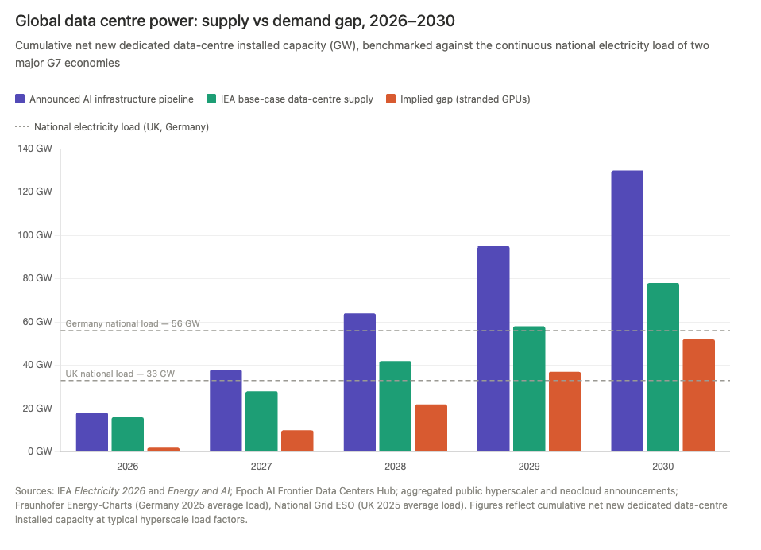
The arithmetic produces a structural supply-demand gap of 30-50 gigawatts by 2030 between the International Energy Agency’s base-case forecast of newly available power supply and the currently announced AI data centre pipeline. The scale is worth putting into a real-world perspective. Germany’s average electricity load across 2025 was approximately 56 gigawatts; the UK’s is roughly 33. The gap between what the grid can deliver and what has been announced in AI data centres is therefore comparable to the average power draw of a major European economy. Even halving the announced pipeline to account for projects that never clear interconnection, the gap remains large enough to force a meaningful share of capacity into delay or cancellation.
4. The financing layer
The accounting gap, the NPV cliff on stranded capacity, and supply-side bottlenecks have a common consequence that the industry rarely names but has been acting on for two years. Conventional capital markets cannot finance a build-out of this scale on a timeline compressed by silicon cycles that run four times faster than the physical infrastructure around them. Something had to fill the gap. What filled it is the architecture we examine here: neocloud project finance backed by single-tenant contracts, vendor financing from chip makers to cloud operators, hyperscaler prepayment structures that push working capital up the chain, and the reciprocal commitment loop that binds the whole arrangement together. Each of these structures is rational on its own terms. The question, however, is what happens when they are examined as a single system.
A reasonable objection is that all of this might sort itself out through the secondary market: hyperscalers sell their previous-generation silicon down the cascade to mid-tier users, the implied glut clears, and the depreciation problem disappears. The cascade from frontier training to fine-tuning to inference is real, and for the refurbished-certified segment it is working. What the argument underplays is the balance-sheet constraint on the potential buyers. The major independent AI labs are compute-capacity-constrained but not price-sensitive in the way the cascade argument requires — they will take frontier capacity over discounted legacy capacity at almost any price difference. The mid-tier buyers are chronically capital-constrained and cannot raise the debt to absorb the number of units the cascade thesis projects. The result is that the secondary market, while functioning, is clearing perhaps 30-40% of what the five-year depreciation schedule implicitly requires. The rest sits depreciating against financial models that assume it has already been re-deployed.
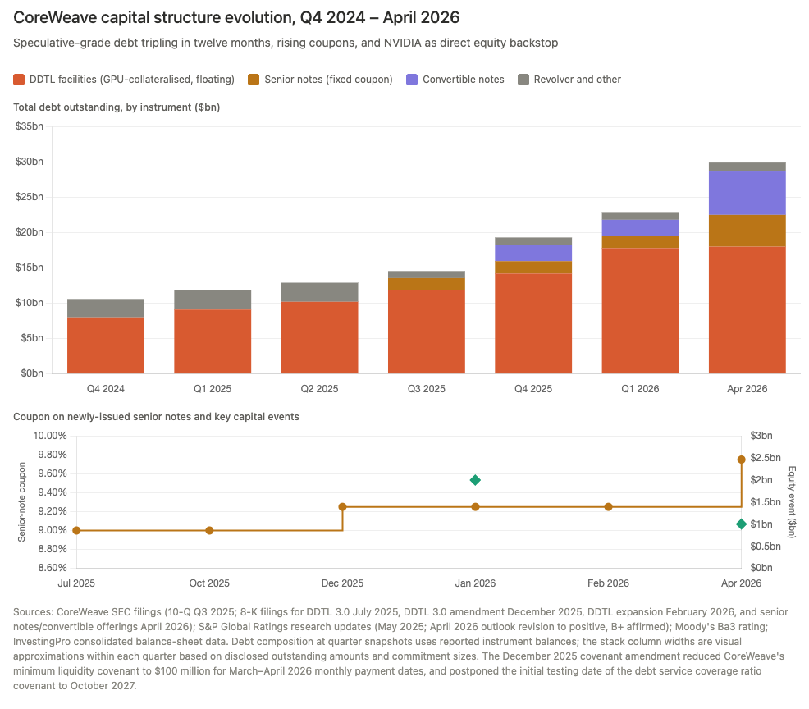
The pressure that surfaces at the hyperscaler tier migrates downstream to the independent AI infrastructure providers — the so-called neoclouds — where the financing structures are more leveraged, the counterparties are more concentrated, and the ability to absorb a correction is lower. CoreWeave is the prime example of this. The company’s adjusted debt has nearly tripled, from roughly $11bn at the end of 2024 to approximately $30bn by April 2026, with $5.75bn raised in two weeks of April alone at interest rates of 9.75% — the highest the issuer has paid yet. NVIDIA’s direct equity investment of $2bn in January 2026 roughly doubled its ownership stake in exchange for preferential access to next-generation GPUs. This is a vendor financing a customer against the customer’s ongoing purchases of the vendor’s product: a relationship structure with specific historical precedents, none of them reassuring.
9.75%
The interest rate CoreWeave paid on $5.75bn raised in two weeks of April 2026 alone — the highest the issuer has paid yet.
CoreWeave’s free cash flow deficit for 2025 was $7.2bn, funded with debt. Its current ratio at the end of the year stood at 0.46, meaning short-term obligations exceeded liquid assets by more than two to one. In December 2025 the company quietly amended its senior credit agreement to loosen the minimum liquidity covenant and postpone the initial debt service coverage ratio test, just five months after agreeing to the original terms; the corporate-treasury equivalent of relabelling the expiry date before the carton has left the shop. S&P affirmed the B+ rating with a positive outlook contingent on fixing material weaknesses in internal controls by the end of 2026. The credit market is pricing the risk, not pricing imminent default.
The less-noticed feature of these arrangements is the working-capital structure embedded in the underlying customer contracts. CoreWeave’s most recent quarterly filings disclose that invoices to a significant customer “may, on occasion, carry payment terms of up to 360 days”. The credit agreement governing the senior facility defines a “Cash Trap Event” triggered by, among other things, a large customer failing to pay amounts owed for three consecutive months. Put simply: the lenders have agreed to finance infrastructure that OpenAI is using today and will be paying for, in parts, up to a year later. The exact interim payment schedule is not in the public record: “up to 360 days” is a ceiling, not an average. The economic substance is unambiguous; OpenAI has been granted payment flexibility that supplier-customer relationships of comparable scale in conventional cloud infrastructure do not contain, and the lenders have written a covenant structure that implies they understand the timing risk to be material.
What the lenders are actually extending, once you account for the secondary-market collapse, the up-to-twelve-month gap between revenue recognition and cash receipt, and the concentration of the contracted cash flows on a single counterparty whose own solvency is unsettled, looks more like unsecured working-capital financing to OpenAI, dressed in project-finance clothing. This is the point Patrick Boyle has been making forcefully over the last eighteen months. It is not fraud; the disclosures exist. But the gap between what a credit committee can absorb in twenty minutes and what a forensic accountant would conclude in twenty hours is not fraud either — it is a mismatch of labour that structured credit desks have monetised before, and the 2007 cycle is where the current cohort of credit committees should have learned that lesson. Apparently not well enough.
The question is whether the same pattern also exists at the next tier up, where it is harder to hide: Oracle is the test case here. OpenAI’s $300bn five-year cloud commitment represents roughly 57% of Oracle’s $553bn backlog. Oracle’s most recent quarterly disclosure made clear how the asymmetry has been resolved: for the large AI contracts driving backlog growth, most of the equipment needed is either funded upfront via customer prepayments, or the customer buys the GPUs and supplies them to Oracle. Ninety per cent of Oracle’s 10 gigawatts of committed capacity is “funded through partners”. Oracle’s balance sheet does not absorb the working-capital strain; OpenAI’s does. To fulfil the Oracle contract, OpenAI must wire prepayment funds on Oracle’s capex timeline rather than on OpenAI’s revenue timeline. That cash must come from either equity raises, any remaining NVIDIA tranches, or the IPO. Whether it can is the binding test. The working-capital mechanism that CoreWeave’s lenders quietly absorbed has not been retired; it has been transferred one tier up and made several times larger.
5. Money in a circle, and the keystone
The argument until now has traced a system. The accounting lag on the hyperscaler balance sheets, the NPV cliff on stranded clusters, the supply-side bottlenecks on power, the financing structures the neoclouds built to bridge their funding gap — each of these is a component. The engineering question about a system is what happens at the seams.
The reciprocal commitments at the top of the stack, now well documented, have become a loop: NVIDIA pledged up to $100bn to OpenAI against hardware deployment; OpenAI signed a $300bn cloud agreement with Oracle, against which Oracle committed roughly $40bn to NVIDIA chips; AMD granted OpenAI warrants to acquire 10% of AMD at a penny a share, contingent on 6 gigawatts of deployed capacity; Microsoft holds $13bn-plus in OpenAI while OpenAI has committed $250bn of cloud spend back to Microsoft; and NVIDIA holds 7% of CoreWeave and has agreed to purchase $6.3bn of CoreWeave’s capacity. This is not a series of bilateral deals: it is a loop.
Before examining where the loop gives, the defensible version of the bull case is worth stating in full and taking seriously. It runs approximately as follows:
First, vertical integration between NVIDIA, OpenAI, Oracle and CoreWeave is not a fragility but a feature. It internalises transaction costs that arm’s-length markets could not price efficiently at this scale and speed, and it allocates scarce compute capacity to its highest-productivity users faster than spot markets could. That is what vertical integration is supposed to do. The reciprocal commitments look circular because they are — the participants are hedging one another’s execution risk through capital rather than through contract, because contract enforcement at this scale and compression would be too slow.
Second, OpenAI’s revenue trajectory genuinely supports an aggressive valuation. The company has grown recognised revenue from effectively zero to $13bn in under four years, a pace that exceeds any enterprise software business at an equivalent stage. If the addressable market for AI-native software services is on the order of $1-2tn by 2030 — which is roughly what the bulls argue — then OpenAI capturing even a mid-single-digit share of it produces a company with revenue in the $60-100bn range and conventional software margins. A $1tn valuation against that projected cash flow is aggressive but not absurd, and the comparison to 1999 misses that the Internet’s revenue base in 1999 was less than 2% of what global e-commerce would become. The multiple is pricing the trajectory, not the current income statement.
Third, the IPO does not need to be cleared as a single public offering. A combination of structured tranches, sovereign anchor investors willing to hold for longer than the public market would tolerate, direct listings of employee shares, and secondary block placements can absorb the volume in ways the Facebook-Google-Alibaba benchmark does not contemplate. The $150bn public-market-absorption problem is a feature of a specific offering structure, not a feature of the underlying demand for exposure to the company.
Fourth, even a delayed, downsized, or restructured IPO can clear the financing stack because the commitment loop creates mutual hostages, not mutual risk. NVIDIA will not force CoreWeave into default because that would damage its equity stake and revenue; Oracle will not call OpenAI on payment terms because the $300bn contract is worth more than half of what Oracle itself is currently worth; Microsoft will not mark down its OpenAI stake aggressively because that would create a hole in its balance sheet. The connectedness that the bear case reads as contagion risk, the bull case reads as stabilising among parties who each need each other to survive.
All four together make a serious argument. It may turn out to be right, and the piece’s conclusions depend in part on it being wrong. The reasons to doubt it are not the individual preconditions for the IPO to clear — those can be listed, but listing them implies an independence and a uniform weight that the actual structure does not have. The reasons to doubt it reduce to one underlying requirement that sits underneath all of the bull case’s separate assertions.
The binding requirement is, put bluntly, cash. Commitments inside the loop can keep going around — building contractors expect to get paid. OpenAI has contracted to prepay, or to directly fund, roughly $300bn of Oracle capacity over five years. It owes $250bn of cloud commitment to Microsoft over a comparable period. It carries operating losses projected at $14bn in 2026 alone, against $13bn of recognised revenue, with the deficit compounding through at least 2027 before the projected revenue ramp catches up. The aggregate cash demand on OpenAI over the 2026-2028 window, across prepayments, operating funding, and contracted capacity commitments, is somewhere on the order of $150-200bn. That cash has to come from somewhere. The remaining NVIDIA tranches, reduced from a pledged $100bn to a realised $30bn, cover a fraction. The SoftBank bridge covers a fraction. Microsoft’s equity position cannot be further drawn without antitrust and governance friction. The Gulf capital that would have anchored the next ring is compromised. The IPO is not the preferred funding path. It is the only remaining one at the required scale.
$150–200bn
What OpenAI needs to raise across prepayments, operating funding and contracted capacity commitments between 2026 and 2028 — from sources that have already partially withdrawn.
This reframes the inverse question. The bull case needs to not just show that the IPO can price, or that the valuation can hold, but that the cash can arrive on the schedule the prepayment commitments require. A number of conditions would need to hold simultaneously for that to happen:
- The offering prices at or above $1tn, preserving the valuation every downstream commitment was underwritten against.
- The float is large enough to raise materially more than $50bn — closer to the 15% Facebook-Google-Alibaba benchmark than the 5% Aramco precedent, which would demand roughly a third of a typical year’s total US IPO capacity for a single issuer.
- Equity multiples and credit spreads survive the pricing window intact, without further geopolitical escalation.
- Neither Microsoft, Oracle nor AWS publicly revises its commitment schedule in the marketing window.
- None of Microsoft, Alphabet or Meta follows Amazon in shortening server useful lives before pricing.
- The SoftBank and NVIDIA walkbacks prove to have been the last such revisions rather than the first.
Each of these is individually plausible. The problem is that they are not independent conditions that can be multiplied through to produce a clean probability: they are correlated expressions of the same underlying requirement that the cash arrives, on time. A single commitment revision or a single anchor-tenant renegotiation in the marketing window will move all of them against the offering at once, because the market will read one as the signal for the rest. Like compound interest in reverse — a small discount across correlated preconditions corrodes the overall likelihood quickly. The required outcome is not any one of these individually. It is that the cash arrives, on the schedule the structure requires, at the price the structure needs, into the teeth of a system that gives the market multiple reasons to believe it will not. To be explicit about the scale, this requires $150-200bn from sources that have already partially withdrawn. In other words, it would be nothing short of a financial miracle.
The first signs that the loop has reached the edge of its available capital are already here: first, in the final weeks of 2025 and the opening months of 2026, to meet its $40bn commitment to OpenAI, SoftBank liquidated its entire NVIDIA position, sold $4.8bn of its T-Mobile US holding, drew down $11.5bn of margin loans against Arm, and arranged a $40bn twelve-month unsecured bridge loan from JPMorgan, Goldman and three Japanese banks — the largest pure-dollar financing in its history. S&P moved the outlook to negative in early March citing OpenAI concentration. The rating is already below investment grade. Masayoshi Son now personally signs off on any deal above $50m at the Vision Fund. Second, NVIDIA, for its part, has walked back the September 2025 announcement, formally flagging in subsequent filings that the $100bn investment might not fully materialise; Jensen Huang has stated that the recent $30bn tranche “may be their last.” The difference between a committed $100bn and a realised $30bn is $70bn of equity funding now withdrawn from the structure. The Gulf capital that had been the next ring is compromised by the Iran conflict. The IPO is no longer one of several exits: it is the only exit.
The OpenAI IPO has become the keystone of the entire financing edifice — the single element whose shape the rest of the structure has been cut to match. Get the keystone slightly wrong and the arch goes into rapid, uncontrolled disassembly.
A disappointing IPO outcome — not a failed one, merely disappointing — propagates simultaneously through multiple load-bearing connections: SoftBank’s $40bn bridge would require refinancing at materially worse terms; NVIDIA’s walked-back commitment would take a formal mark; Oracle would lose the prepayment mechanism that protects its balance sheet; CoreWeave’s covenants come back for a second renegotiation; AMD’s warrant structure compresses; Microsoft’s one-off $7.6bn equity-method gain, which came from OpenAI’s recapitalisation rather than from recurring earnings, reverses on the next valuation re-rating. Each of these is serious in isolation. The keystone property is that they fire simultaneously, because each is anchored to the same event.
To put it into perspective, the scale of what this one IPO has to clear is without recent precedent. Aramco’s December 2019 listing, the largest in history, originally targeted a 5% float at a $2tn valuation to raise $100bn. International investors balked. The eventual listing was a domestic-only 1.5% float at a $1.7tn valuation raising $29.4bn, backed by captive Saudi retail investors who were offered subsidised loans to participate. The largest IPO in history was the diminished version of a plan the market rejected. An OpenAI listing at a $1tn target valuation faces a harder version of the same problem: a scale that exceeds the market’s historical capacity to absorb, on a business whose cash-flow profile is the opposite of the one that set the previous record, and without a sovereign backstop of comparable scale. The Gulf capital that might have anchored the book in 2024 is absorbed by post-Ras Laffan reconstruction. SoftBank has exhausted its balance sheet. NVIDIA has walked back the equity commitment that would otherwise have been the natural anchor bid.
6. The capital backdrop
If the keystone goes, the damage propagates through two channels. The first is direct: through the public equity of the named counterparties, which reprice quickly and transparently. The second is indirect, operating through the institutional capital layer, and is the one worth a brief walk-through because it explains why the correction will be broader than the named counterparties suggest.
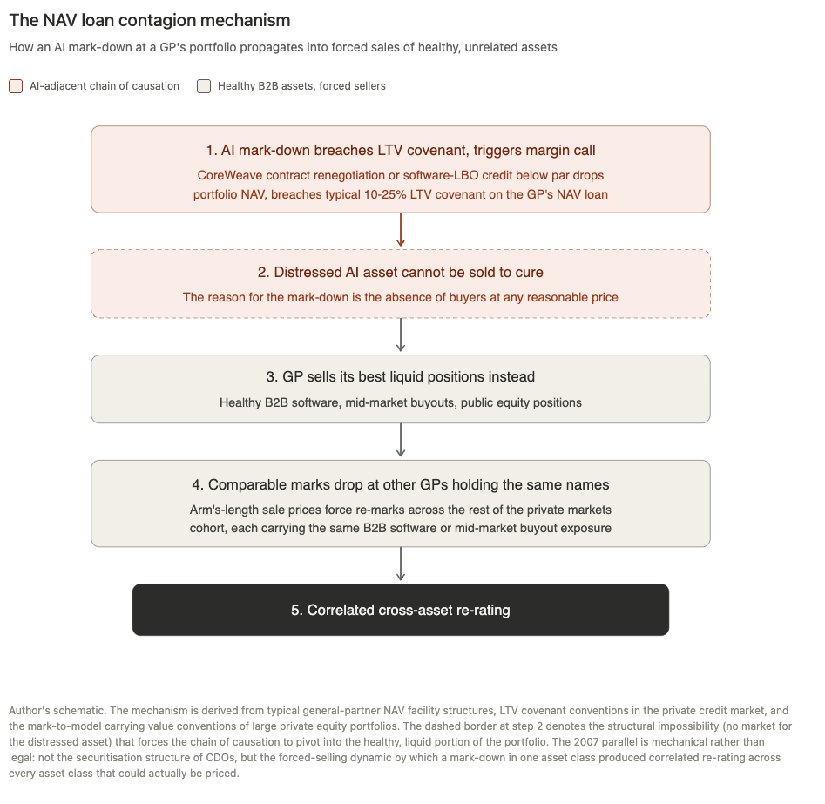
The mechanism is old; the scale is new. Private equity funds carrying AI-adjacent positions have been collateralising loans — borrowing against the marked-to-model, aggregate value of their holdings to fund distributions. A disappointing OpenAI outcome forces an arm’s-length re-rating of those positions. Because the distressed AI assets cannot be sold at the marked price, the covenant is cured by selling healthy, liquid, unrelated positions instead: B2B software, mid-market buyouts, public equity stakes, which drops comparable marks at every other fund holding the same names. The AI re-rating propagates laterally into asset classes structurally unrelated to AI. PIMCO’s reduction of carrying values on a private-credit book in late 2025 was the first arm’s-length mark to puncture the convention at scale; the February 2026 software-credit selloff forced the five largest alternative managers to defend their underwriting publicly. Neither event has yet triggered a full cascade, but both establish that the plumbing exists and is active.
If the institutional capital layer cannot supply the marginal dollar, the natural next question is which pool can. For most of 2024 and 2025, the Gulf was supposed to be the next ring of available capital. Saudi Arabia and the UAE positioned themselves as the unencumbered anchor for the build-out, with the HUMAIN initiative, the Stargate UAE project (1 gigawatt first phase of an eventual 5-gigawatt campus), and a series of smaller facilities representing a planned multi-hundred-billion-dollar deployment of sovereign wealth on terms that bypassed both American grid constraints and American regulatory friction. The American-Israeli strikes on Iran on 28 February 2026 ended that proposition within a long weekend. Iranian drone retaliation hit AWS facilities in the UAE and Bahrain. On 3 April the Islamic Revolutionary Guard Corps released a video naming the Stargate UAE campus as a designated target conditional on continued American action against Iranian energy infrastructure: the first known case of a state actor publicly designating a commercial AI facility as a target. Commercial data centres, in the phrasing of one widely circulated analyst note, are large, relatively fragile, and lack dedicated air defences. Drone interceptor inventories have been substantially depleted by the conflict, and production cannot replenish them on a timescale relevant to the current operational window. The Gulf as the next AI compute frontier is not dead: the underlying solar resources, sovereign capital, and political alignment remain, but the timeline has been pushed out by years.
Europe is the final potential escape hatch and is narrower than the sector pretends. The American option has concentrated into a handful of states — Virginia, Texas, Georgia, Ohio — whose grid operators have either accelerated interconnection or whose regulatory regimes permit substantial private, behind-the-meter generation. The European option concentrates potential capex into three national grids: France, the Nordics, and Iberia — each with its own constraint profile. France offers centralised state-aligned procurement but the same centralisation makes gigawatt foreign-owned campuses politically fraught. The Nordics have the generation mix but are limited by cross-border transmission. Iberia has the solar economics but the generation is in the south and the demand is in the centre. Realistic combined capacity additions across the three geographies total perhaps 12-16 gigawatts by 2030, against a European share of the announced pipeline that is multiples of that. Overlay the EU’s fragmented AI regulatory trajectory and wider energy transition ambitions and the escape hatches are closing.
7. The asymmetric bet, and what to watch
The question that follows a correction is who owns the infrastructure afterwards — and the answer narrows faster than most commentary suggests. When leveraged structures unwind, someone has to buy the distressed neocloud capacity, the stranded gigawatts, the refurbishable fleets. The institutional capital pool is mechanically short of cash and will be selling, not buying. Sovereign wealth funds are compromised either by the Iran conflict or by their existing Vision Fund exposure. Public markets cannot absorb anything at the required scale. Other buyer classes are quickly dispatched: Chinese capital is not permitted by law, other Asian and European strategics lack either the market capability or the capital, distressed-debt specialists are interested in paper rather than bricks, and the amounts involved sit beyond the cash holdings of even the wealthiest individuals. The candidates with the cash, the strategic interest, and the operating capability to absorb distressed AI infrastructure at scale are a small set of the Fortune 10. Microsoft, Meta and NVIDIA are already over-exposed and would at best be hedging existing positions. That leaves only a handful of candidates.
Amazon, having broken ranks on depreciation, is the most capital-disciplined of the cohort and holds roughly $90bn of cash equivalents. It uniquely combines the cash, the operating capability via AWS, and the demonstrated willingness to mark assets honestly. It is well positioned to buy distressed neocloud capacity at significant discount and plug it directly into the AWS estate — the most operationally seamless integration available to any acquirer.
Alphabet holds roughly $100bn of cash, has confined its AI exposure largely to Anthropic and its own hyperscale capex, and has a historical pattern of acquiring infrastructure at the bottom of capex cycles. The company that bought YouTube, DoubleClick and Motorola under analogous market conditions has the institutional muscle memory for this kind of acquisition.
And finally, Apple. It holds roughly $160bn of cash, short-term investments and marketable securities. It has sat out the entire AI capex cycle. Apple’s strategic caution through 2024-26 has been widely read as a failure of AI ambition or as a tacit admission that Siri was never going to catch up. The third reading, however, is that Apple is waiting for the price. The correction the other participants are dreading is the one Apple has been positioned for: whether or not the positioning was deliberate.
Three readings of the 2026 cycle are now in circulation. The first, the bubble reading, holds that the industry is engaged in a coordinated misallocation of capital, sustained by aggressive accounting, circular financing and tolerant credit markets. The second, the strategic-imperative reading, holds that the cost of underinvesting in the AI transition exceeds the cost of overinvesting, and that the correct posture for any incumbent platform company is to deploy capital at whatever level is required to remain in the game. The third reading, increasingly visible in the behaviour of late-2025 capital allocators, is that a correction will come, that it will land disproportionately in the financing layers rather than in the foundational platforms, and that the platforms will emerge stronger and more concentrated. All three can be correct simultaneously; they simply apply to different companies. The strategic-imperative reading is operative for the platforms that will do the acquiring. The bubble reading is operative for the neoclouds, regional sovereigns, anchor-tenant-concentrated financing structures, and the institutional capital layer beneath. Conflating these two groups under a single “AI infrastructure” label is the durable mispricing of the cycle. The third reading, that Apple is waiting for the price — is the most interesting but also the most speculative.
Four falsifiable indicators are worth watching, in order of near-term signal relevance:
- Whether OpenAI can sustain the equity-raising pace required to prepay the Oracle, Microsoft and AWS commitments on schedule, and in particular whether any IPO or pre-IPO round prices at or above the $500bn November 2025 valuation the commitment stack has been underwritten against.
- Whether any anchor-tenant contract collateralising a neocloud loan is renegotiated, or whether any “Cash Trap Event” is triggered under an existing facility.
- Whether a second hyperscaler follows Amazon in shortening server useful lives.
- Whether global gas turbine production, transformer manufacturing, and interconnection queue clearance actually deliver against the announced pipeline.
Each is reported quarterly or better. None has resolved to date.
The promise was capital democratisation. Retail through public neoclouds, institutional through private credit, sovereign wealth anchoring specific facilities — a universe of AI owners broader than any direct hyperscaler build could produce. The correction will produce the opposite. The financing structures unwind; the infrastructure does not. The owners on the far side will be a smaller set of Fortune 10 companies than direct build would have produced.
The financing architecture was built to be ’too big to fail’. What it produces is closer to ’too big to succeed’: scale is what makes the unwind asymmetric, success conditions and survival conditions have diverged, and the price-discovery event will be paid for by the financing layers while the platforms collect the assets. Agency sits with a handful of Fortune 10 companies. The exposure runs through the institutional credit pool, the endowments, the NAV vehicles, the sovereign wealth balance sheets. A small set decides how the assets change hands. Most everyone else pays the bill.
The industry’s most expensive mistakes have come not from being wrong about the technology, but from being wrong about which constraint binds. In 2023 it was the chip. In 2026 it is the electron. By 2030 the binding constraint will likely have moved again, and the structures built for one cycle’s constraint will not all survive the next.
The technology is real. The cash flows are coming. A small set will be there to collect. Most everyone else will pay.